Emerging markets now lead global battery electric car adoption, with Vietnam at 44% BEV share
Summary
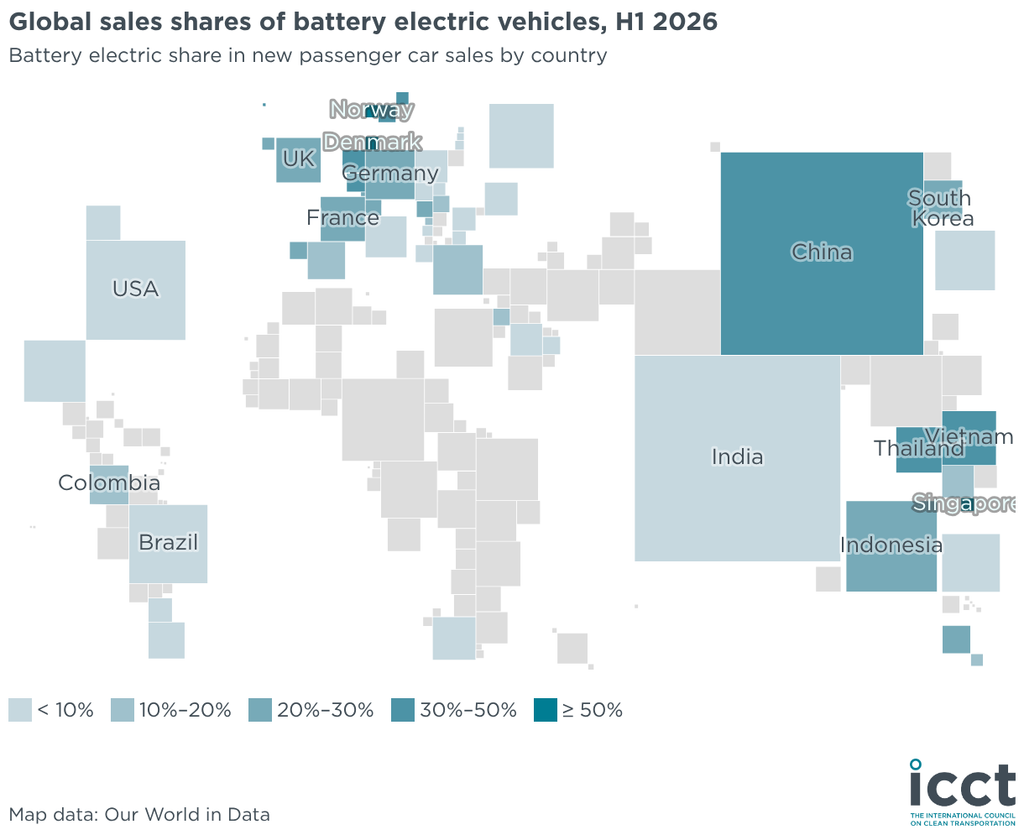
Preliminary H1 2026 data show the fastest battery electric vehicle uptake is occurring outside established markets like Europe, the US and China. Vietnam reached a 44% BEV share of new passenger car sales, ranking fifth globally, with Thailand, Indonesia and Colombia also posting rapid growth.
For the past decade, the prevailing assumption has been that large, wealthy, vehicle-producing markets such as Europe, the United States, and China would lead the transition to battery electric vehicles (BEVs), with emerging markets following several years behind.
But if you haven’t been watching closely, you may have missed how this story is being flipped on its head. Preliminary data for the first half of 2026 show that some of the fastest BEV uptake is happening well outside the more established automotive markets.
Some of the strongest evidence comes from Southeast Asia, where several countries are now posting BEV adoption rates that rival or exceed those in some of the leading markets.
One is Vietnam. In the first half of 2026, the country reached a BEV share of 44% in new passenger car sales, meaning nearly one in two new cars sold was fully electric. That placed the country 5th globally among the 55 markets with available data for both new BEV and total passenger car sales.
Among other emerging markets, Thailand ranked 8th with a 41% BEV share, Indonesia 22nd with 21%, and Colombia 26th with 16%.
Data from EV Volumes, Dataforce, Gasgoo, Segment Y, TAIA, ODMD, ANDEMOS, FENABRAVE, ANAC, VAMA, Hyundai, and GAIKINDO.
Note: Hover over countries to view data for 2023, 2024, 2025, and the first half of 2026. Color shading reflects the share of BEVs in new passenger car sales in the first half of 2026; countries with no available data are shown in grey; square sizes reflect each country’s population.
This momentum is not limited to growing BEV market shares. Some of these countries are also among the world’s fastest growing BEV markets in terms of overall sales.
Between 2021 and 2025, among countries recording at least 100,000 new BEV sales in 2025, Vietnam posted a compound annual growth rate (CAGR) of 574%. Indonesia followed with 255%, while Türkiye and Thailand recorded growth rates of 183% and 181%, respectively.
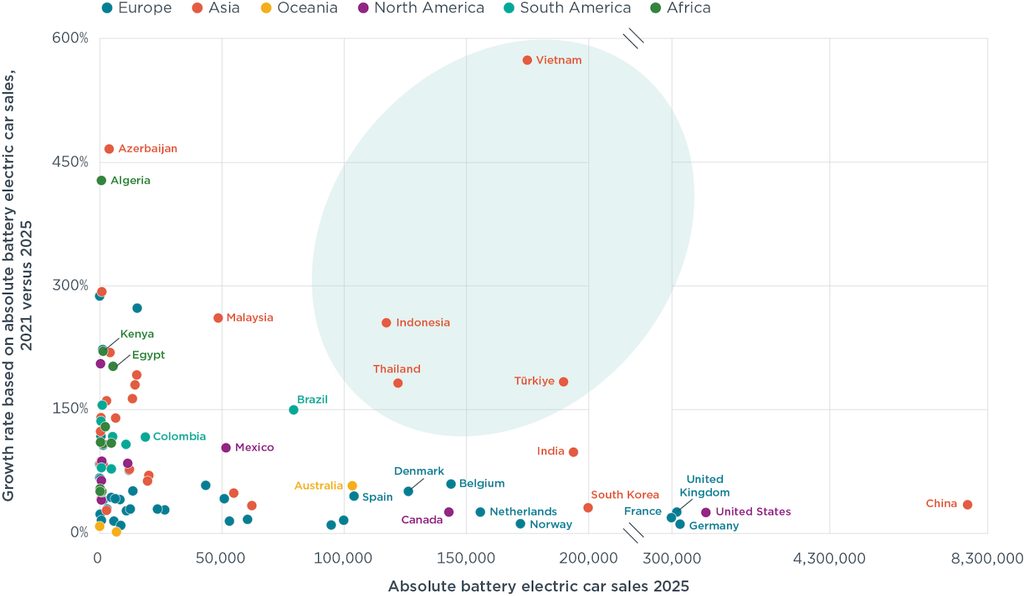
Data from EV Volumes, Dataforce, Gasgoo, Segment Y, TAIA, ODMD, ANDEMOS, FENABRAVE, ANAC, VAMA, Hyundai, and GAIKINDO.
Note: Only includes markets with positive new BEV sales growth between 2021–2025. Left panel includes countries with between 0 and 200,000 new battery electric sales in 2025; right panel shows countries with over 300,000 sales in 2025.
This growth in markets such as Vietnam, Indonesia, Türkiye, and Thailand has been driven by a combination of factors such as BEV incentives, growing model availability, and industrial strategies aimed at developing local BEV value chains and attracting investment. Domestic manufacturers have also played a role, although to varying degrees.
In Vietnam, VinFast, the country’s leading BEV manufacturer, has been the primary driver behind BEV adoption, accounting for almost all new BEV sales in the country. In Türkiye, domestic BEV brand Togg has also supported market growth, alongside a broader set of manufacturers.
The rise of these markets doesn’t mean that the countries with historically high BEV shares are falling behind. Norway (with a 98% BEV share), Denmark (80%), and Singapore (60%) continued to record the highest BEV shares globally in the first half of 2026.
Their success reflects years of sustained policy support for BEV adoption, combining fiscal incentives, taxation systems that favor BEVs, and continued investment in charging infrastructure.
Moreover, the largest passenger car markets by new passenger car sales still dominate in absolute terms. China alone recorded almost 3 million new BEV sales in the first half of 2026, followed by the United States (452,000), Germany (368,000), the United Kingdom (285,000), and France (242,000).
Together, these five markets accounted for 68% of new battery electric car sales globally during the period. Their BEV shares vary widely, though. China reached a BEV share of 35% in the first half of 2026. This was followed by France (28%), Germany (26%), and the United Kingdom (25%). The United States remained the outlier among the major markets, with a BEV share of just 6%.
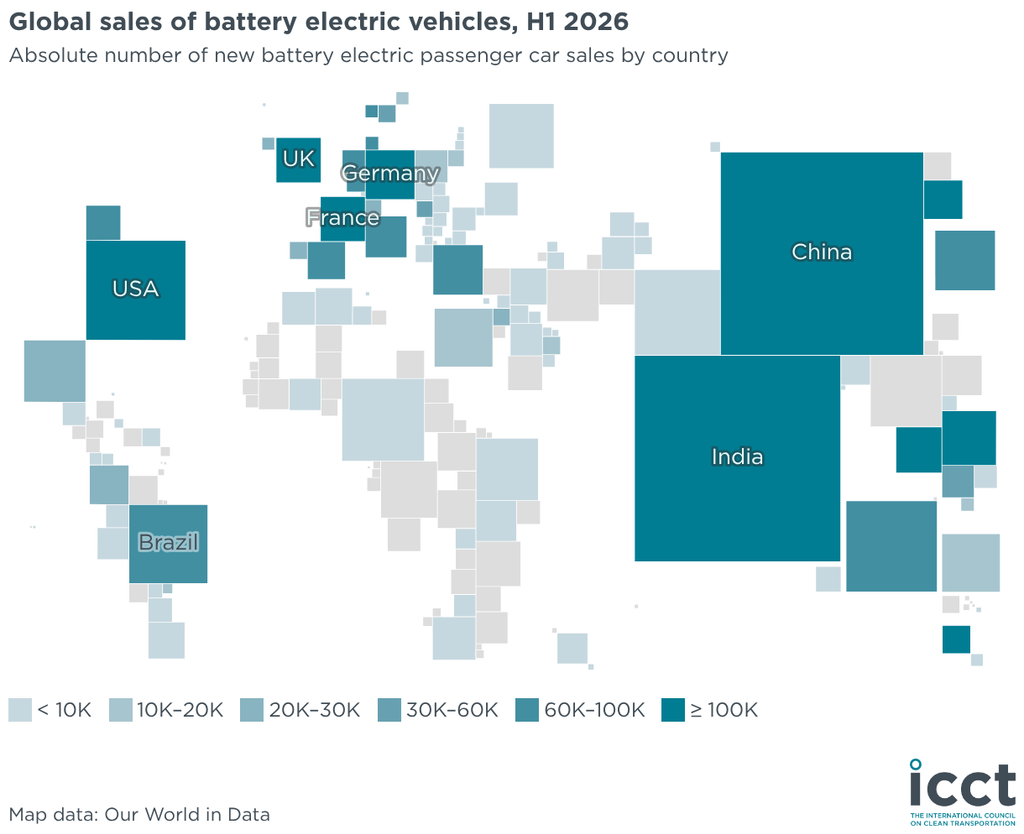
Data from EV Volumes, Dataforce, Gasgoo, Segment Y, TAIA, ODMD, ANDEMOS, FENABRAVE, ANAC, VAMA, Hyundai, and GAIKINDO.
Note: Hover over countries to view data for 2023, 2024, 2025, and the first half of 2026. Color shading reflects the number of new BEV sales in the first half of 2026; countries with no available data are shown in grey; square sizes reflect each country’s population. Data source: EV Volumes.
The key takeaway is that the geography of the BEV transition is broadening. While a relatively small number of countries still account for most global BEV sales, some of the fastest growth is now occurring in markets that were once expected to trail far behind.
*Note: Definitions of passenger cars vary across markets and statistical sources. In some markets, passenger cars may include certain light-duty vehicles, such as pickup trucks, while in others these vehicles are classified separately.
First published at the International Council for Clean Transportation. Reproduced with permission.


Comments
No approved comments yet. Be the first to comment.
Leave A Reply