Florida 11-Year-Old Cited for Riding 4,500W Electric Motorbike on Public Roads
Summary
An 11-year-old in Oviedo, Florida was cited, fingerprinted, and given a court date after police stopped him riding a high-powered Sur Ron-style electric motorcycle, which falls outside the state's e-bike definition. The case highlights a debate over enforcing existing e-bike laws rather than passing new ones.
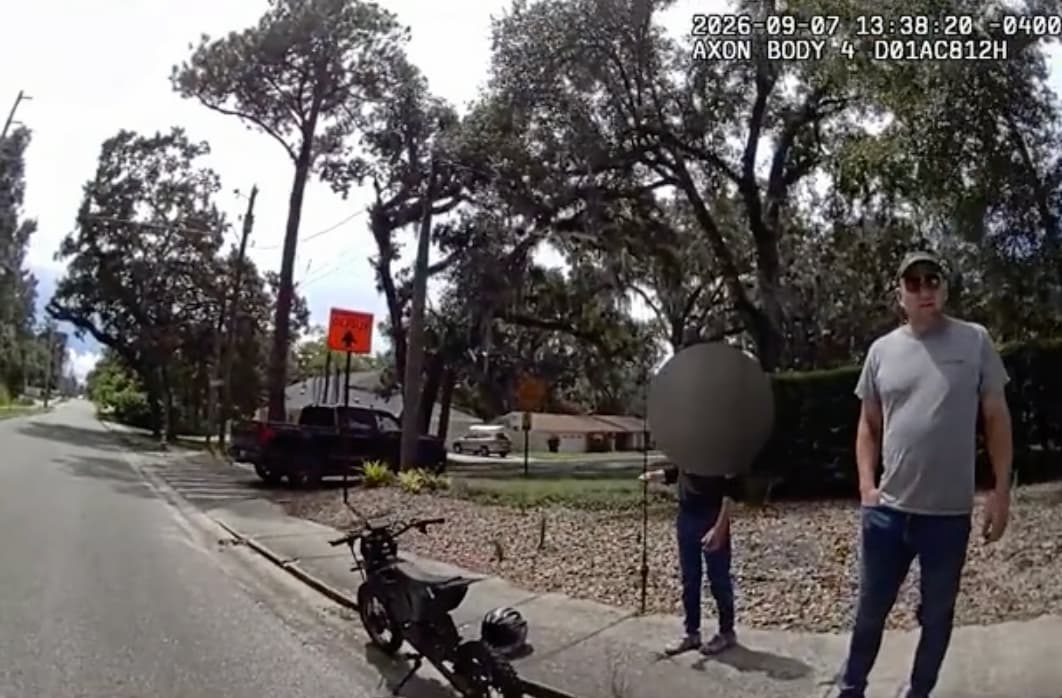
An 11-year-old boy in Florida has found himself with a traffic citation, a towed electric motorcycle, and a court date after police caught him riding a high-powered electric dirt bike in lieu of an electric bicycle on public roads.
It’s a rare example of an alternative to the growing push for stricter e-bike laws nationwide: actually enforcing the perfectly good laws we already have.
And while there’s certainly room to debate whether fingerprinting an 11-year-old and sending him to court is the best way to handle the situation, the underlying enforcement may be exactly what we need more of.
The incident occurred earlier this month in Oviedo, Florida, where police stopped an 11-year-old while he was riding an electric motorbike toward a nearby fishing spot.
But there was one rather significant problem: This wasn’t actually an electric bicycle like the Class 1, 2, and 3 e-bikes permitted by law in most of the US. It was actually a member of a group of electric two-wheelers more commonly referred to as “e-motos.”
Oviedo police described the machine as a Sur Ron-style 4,500-watt electric motorcycle with foot pegs instead of functional pedals. Under Florida law, an electric bicycle must have operable pedals and an electric motor rated at no more than 750 watts, in addition to meeting the state’s speed-based e-bike classifications (up to 20 mph for Class 1 and 2, or up to 28 mph for Class 3), among other restrictions.
Police said the vehicle was capable of around 50 mph, while the boy’s father has claimed it was limited to 20 mph, according to local news affiliate WFLA. Either way, the lack of pedals and 4,500-watt motor put it well outside Florida’s legal definition of an electric bicycle.
As an electric motorcycle being operated on public roads, police said the vehicle would need to be registered and meet applicable DOT requirements, while its rider would need a driver’s license with a motorcycle endorsement. An 11-year-old obviously checks none of those boxes.
Police ultimately cited the boy for operating an unregistered motor vehicle, though officers said there were several other violations they could have cited. His bike was also towed, and because he didn’t have a driver’s license or other identification, officers fingerprinted him before giving him a mandatory court date.
There’s a legitimate discussion to be had over how exactly to handle an unaccompanied 11-year-old riding an unregistered and non-street-legal motorcycle. But the bigger message is likey that enforcemenet of some kind is warranted. And it comes at a time when legitimate electric bicycles – the 20-28 mph kind with real pedals – are increasingly being caught in the crossfire.
Cities and states around the US scramble to respond to complaints about children and teenagers riding Sur-Ron-style electric motorcycles on streets, sidewalks, bike paths, and other public spaces, but the response often ends up with proposed bans that sweep up legal e-bikes along with the illegal variety.
We’ve seen lawmakers propose everything from e-bike registration and licensing requirements to new age restrictions and even attempts to further restrict legitimate Class 3 electric bicycles.
But many of the machines causing the most concern aren’t e-bikes in the first place.
A 4,500-watt pedal-less electric dirt bike doesn’t become an e-bike simply because its motor is electric. If an 11-year-old were riding a 50cc gas dirt bike down the same public road, nobody would be debating whether we needed to rewrite bicycle laws to address it.
The same principle should apply here.
Electrek’s Take
This is exactly why I’ve argued that better enforcement should come before piling new restrictions onto legal e-bike riders.
There are absolutely legitimate concerns surrounding kids riding high-powered electric motorcycles. These machines can reach motorcycle speeds, often lack the equipment necessary for street legality, and are increasingly winding up in the hands of riders who are far too young to legally operate motorcycles.
But we already have laws covering that.
If someone is riding an unregistered electric motorcycle on public roads without a license, registration, or insurance, then enforce the motor vehicle laws. If a teenager is riding a modified e-bike that no longer meets the legal definition of an e-bike, enforce the rules that apply to that vehicle.
That approach makes considerably more sense to me than imposing new licensing, registration, or other restrictions on millions of people riding perfectly legal Class 1, 2, and 3 e-bikes because authorities have struggled to deal with illegal electric motorcycles.
I’m not particularly interested in cheering for an 11-year-old getting fingerprinted or having to appear before a judge. He was apparently just trying to go fishing, not terrorize the neighborhood.
But police stopping an 11-year-old from riding a 4,500-watt electric motorcycle on public roads? That part seems pretty reasonable.
Perhaps the bigger lesson here isn’t that we need another round of e-bike laws. Maybe we just need to enforce the ones we already have.


Comments
No approved comments yet. Be the first to comment.
Leave A Reply