Rider Becomes First to Circumnavigate Australia on an Electric Motorbike in 95 Days
Summary
Ed Darmanin completed an 18,446-kilometre lap of mainland Australia on an electric motorcycle, becoming the first person to do so without using a single litre of petrol. His journey drew hundreds of thousands of views online and sparked debate after he compared a $3.09-per-litre diesel price with a $3.00-per-kWh fast charger on the Nullarbor.
Ed Darmanin rang me a week ago, all excited. He was home after his epic electric motorcycle journey around Australia. The Big Lap. You can read the first two parts here and here.
The most exciting thing to me was the effect the ride had caused. According to the Macquarie Dictionary, stirring the possum is an Australian slang phrase for creating a disturbance, provoking controversy, or livening things up. He certainly did. Along the way, he rode on the beach, rode through bushfires, played golf on the Nullarbor, and battled dead chargers and diesel loyalists. As an appendix, Ed has included some of the links from various media outlets that picked up the adventure.
The Numbers Tell the Story
Ed rolled back into Sydney on 27 September, 95 days and 18,446 kilometres after he left — the first person to circumnavigate mainland Australia on an electric motorcycle, without using a litre of petrol along the way. As he puts it: “I rode past every petrol bowser for 18,000 kilometers. I didn’t need a single one.”
Ed’s Facebook following went from 85 at departure to 1,343 by the finish, with individual reels clearing 110,000 views and combined views across the trip approaching 700,000. The audience skews heavily male (86–94%), 45+, predominantly Australian — not a demographic you’d expect to be an easy sell on electric vehicles, which is part of what makes the engagement notable.
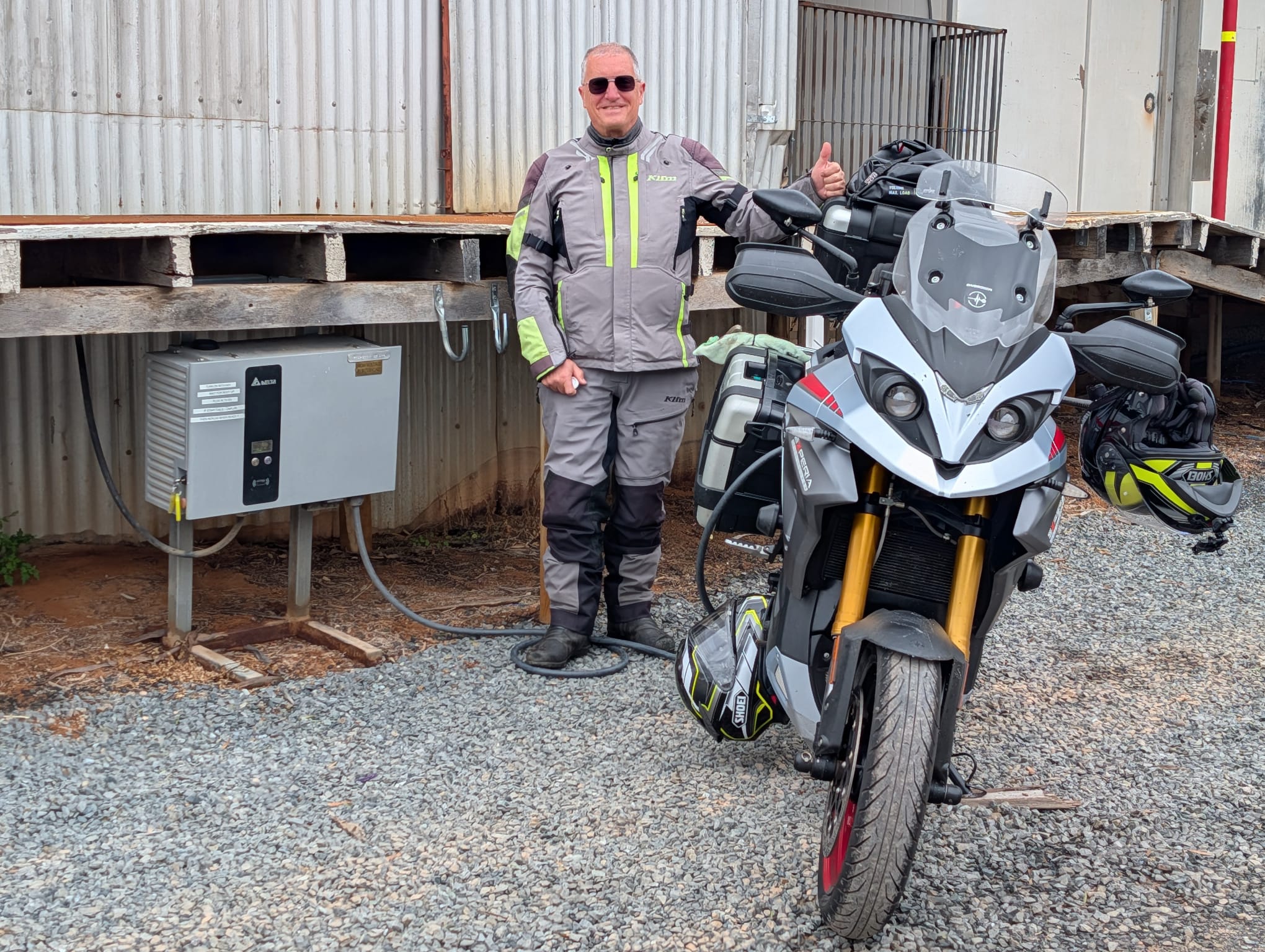
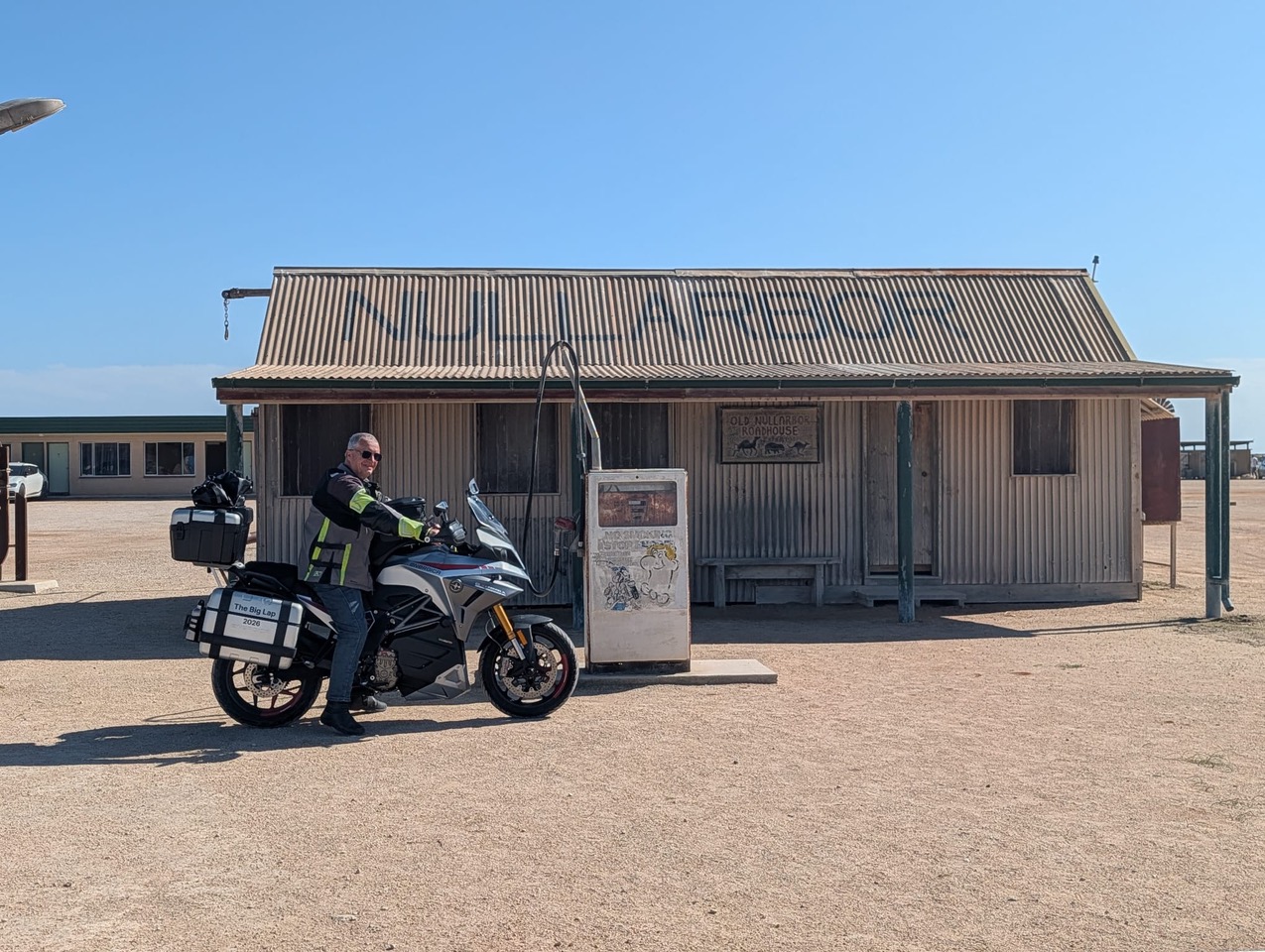
The Balladonia diesel-price post is the clearest case study in what happened when Ed’s ride met the algorithm. At that roadhouse in the Nullarbor, diesel was $3.09 a litre. The ageing DC fast charger — a Delta unit Ed had used four years earlier during his LiveWire crossing, the first electric Nullarbor crossing on record — was charging $3.00 a kilowatt-hour. He filmed the comparison and posted it. Eighty thousand views in 24 hours, and a proper argument erupted in the comments: diesel advocates vs. an electric machine that had already covered more than 14,000 km around the country on grid power and sunlight.
Ed expects that reaction now and treats the pushback as useful rather than a problem: “It’s evidence the message is landing somewhere that matters — the same pattern you’ve tracked with EV cars now showing up in a market everyone assumed would stay petrol forever.” He runs a light-touch moderation policy — a keyword filter to manage serial haters, genuine engagement with real questions, and a decision to let factual debates run rather than delete them — which is arguably its own small story about how to run effective public-facing EV advocacy. You can read the post and comments here.
Media and the Bigger Picture
The coverage backs the numbers up at a larger scale. ABC News Digital ran the completion story nationally on 27 September, picked up internationally within hours — outlets in Ukraine and Hungary among them. Along the way: ABC Radio in Sydney (Craig Reucassel, twice — departure and completion); ABC Townsville — Mount Isa, Darwin, Gippsland, and Broome; regional print and digital from The Sentinel in Gippsland and CQ Today in Queensland; Adelaide’s Coast FM MotoChat (a 45-minute segment – ); and international motorcycle press — Buck City Biker in the UK, The Pack News in Europe, Onroad.hu in Hungary. Bike Magazine UK has commissioned a full feature off the back of it, with UK rights going to them and Ed retaining Australian and international rights.
What’s striking about that media footprint isn’t the volume — it’s where it landed. Motorcycle press, outback radio, regional newspapers, national broadcast. These are not EV-friendly bubbles. These are the audiences the transition actually needs to reach, and a retired electrical engineer from Sydney’s Northern Beaches on an Italian electric adventure tourer got their attention by doing something real rather than running a campaign.
South from Broome: Fire, Sand, and Ghost Chargers
By Broome, Ed had covered roughly half the 18,000 km lap. What remained was the Western Australia coast, the Nullarbor crossing, and the run down the southeast coastline into Sydney — in some ways the most technically demanding part of the journey, and the one that produced the most pointed infrastructure observations.
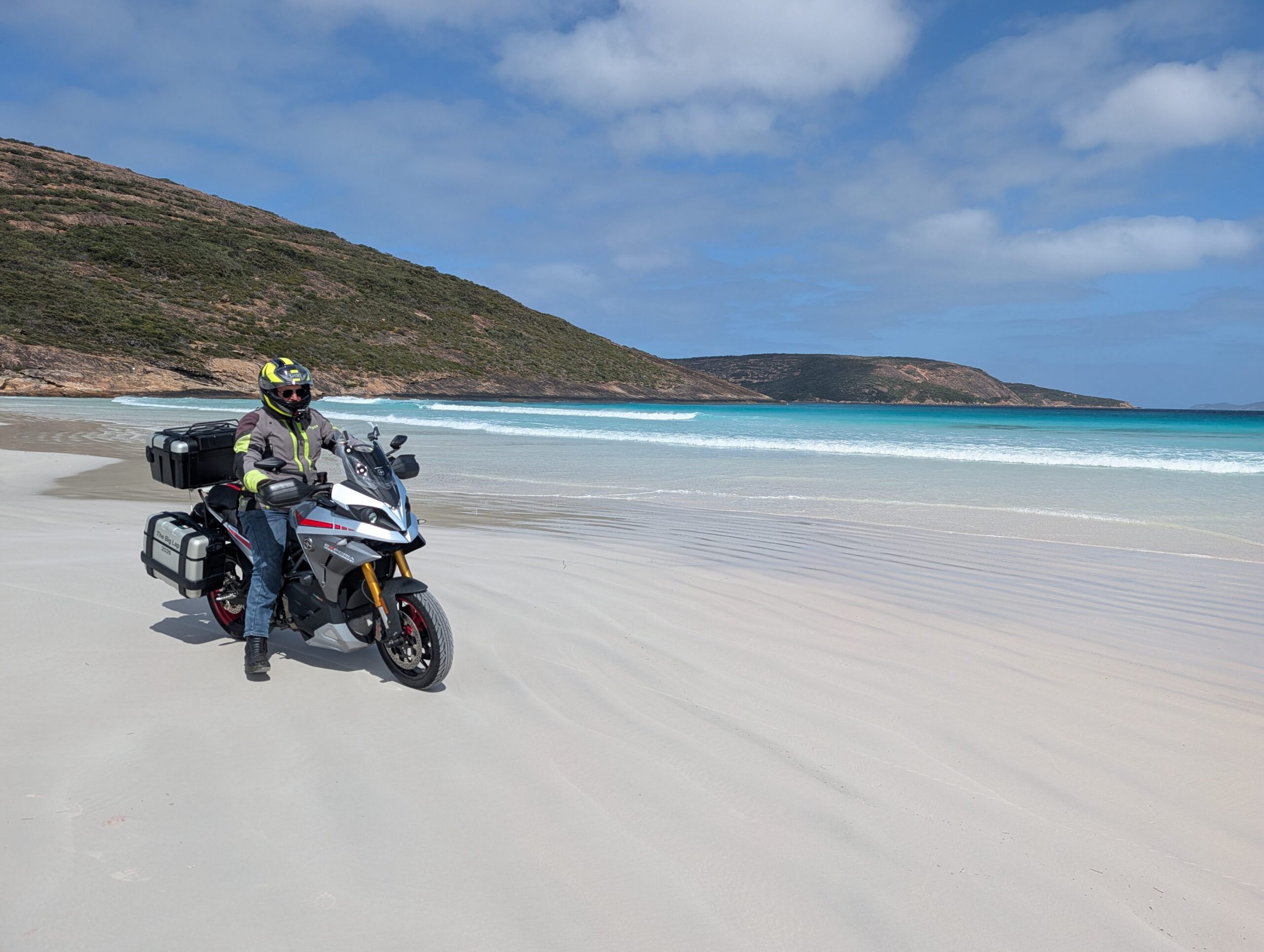
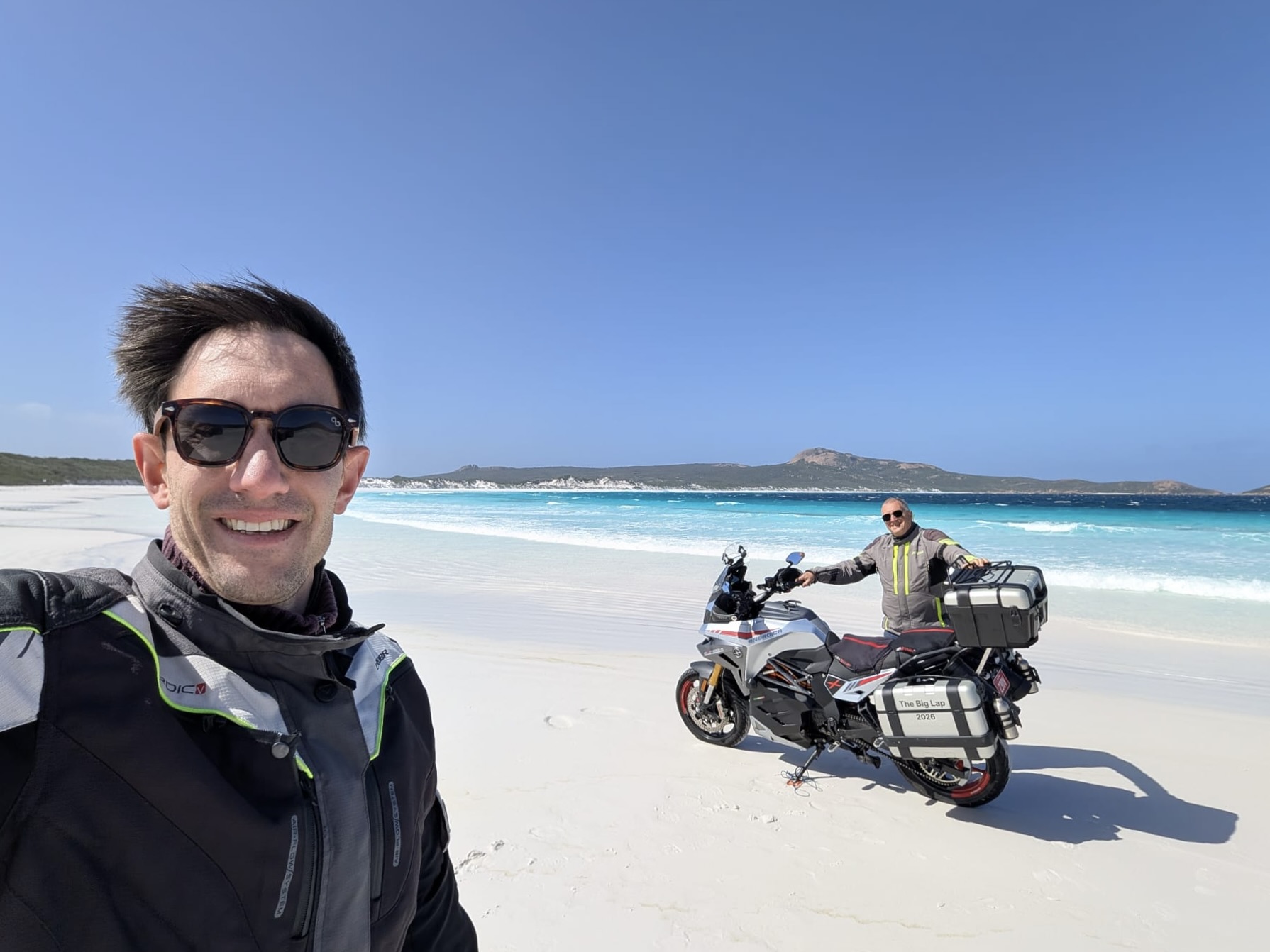
New tyres went on in Broome — Pirelli Angel GT IIs ahead of the Western Australia coast run — and with his wife Sally on the pillion seat, the road south began with a stop at Barn Hill Station: red desert soil running straight into white sand and turquoise water, and a conversation with Janice, who built and still runs the place, fresh off two days fighting fires that had been threatening the property.
The fires weren’t just a backdrop. Back on the coastal highway, Ed and Sally rode through smoke close enough to taste, with flames working through scrub a few metres off the bitumen. They got through just ahead of the road closing behind them. At Bidyadanga, the DC fast charger was offline — so it was the slower Level 2 socket instead, a patient top-up that bought enough range to reach Sandfire Roadhouse.
Further down the same highway, at Whim Creek and Fortescue River (Mardie), he found solar-powered DC fast chargers still live and working at roadhouses that had otherwise shut down entirely — no fuel, no food, no toilets. Just a charger outlasting the business that built it. Both are confirmed live on PlugShare and Chargefox, and Ed flagged them as a data point worth paying attention to: in some cases, the EV charging infrastructure is now more reliable than the petrol supply it was meant to supplement.
The route tracked the coast through Ningaloo Reef and Monkey Mia (both World Heritage listed), then Coral Bay and Carnarvon, before swinging inland toward Perth, where a group of local EV owners met Ed and Sally for dinner to see the bike and trade notes on the trip.
The Nullarbor: Infrastructure at the Edge
The Nullarbor crossing is where the charging question becomes pointed. There are no shortcuts, no alternate routes, and the distances between stops are long enough that a headwind doesn’t just slow you down — it changes the arithmetic of whether you make it at all.
By Esperance, with Ed’s son Evan now on the pillion seat, the decision wasn’t which road to take but whether to leave at all. A 30–45 km/h headwind was forecast directly over the crossing for the days they’d planned to ride — confirmed against actual Bureau of Meteorology records. They waited two days. The days they would have ridden into took three straight days of wind and rain; they crossed later under clear sky with the wind behind them.
That kind of decision — treating a weather window as a genuine go/no-go rather than a minor inconvenience — reflects something broader about how long-distance EV travel in remote Australia actually works. Planning, real-time data, and the willingness to adapt aren’t nice-to-haves; they’re the margin between completing the leg and calling for a tow.
The crossing itself produced some of the trip’s more memorable infrastructure moments. A Delta fast charger at Balladonia — the same unit Ed had used four years earlier — was still operational and produced the diesel-price comparison post described above. The coverage across the crossing is thin but workable; what it requires is understanding the gaps in advance rather than discovering them on the road.
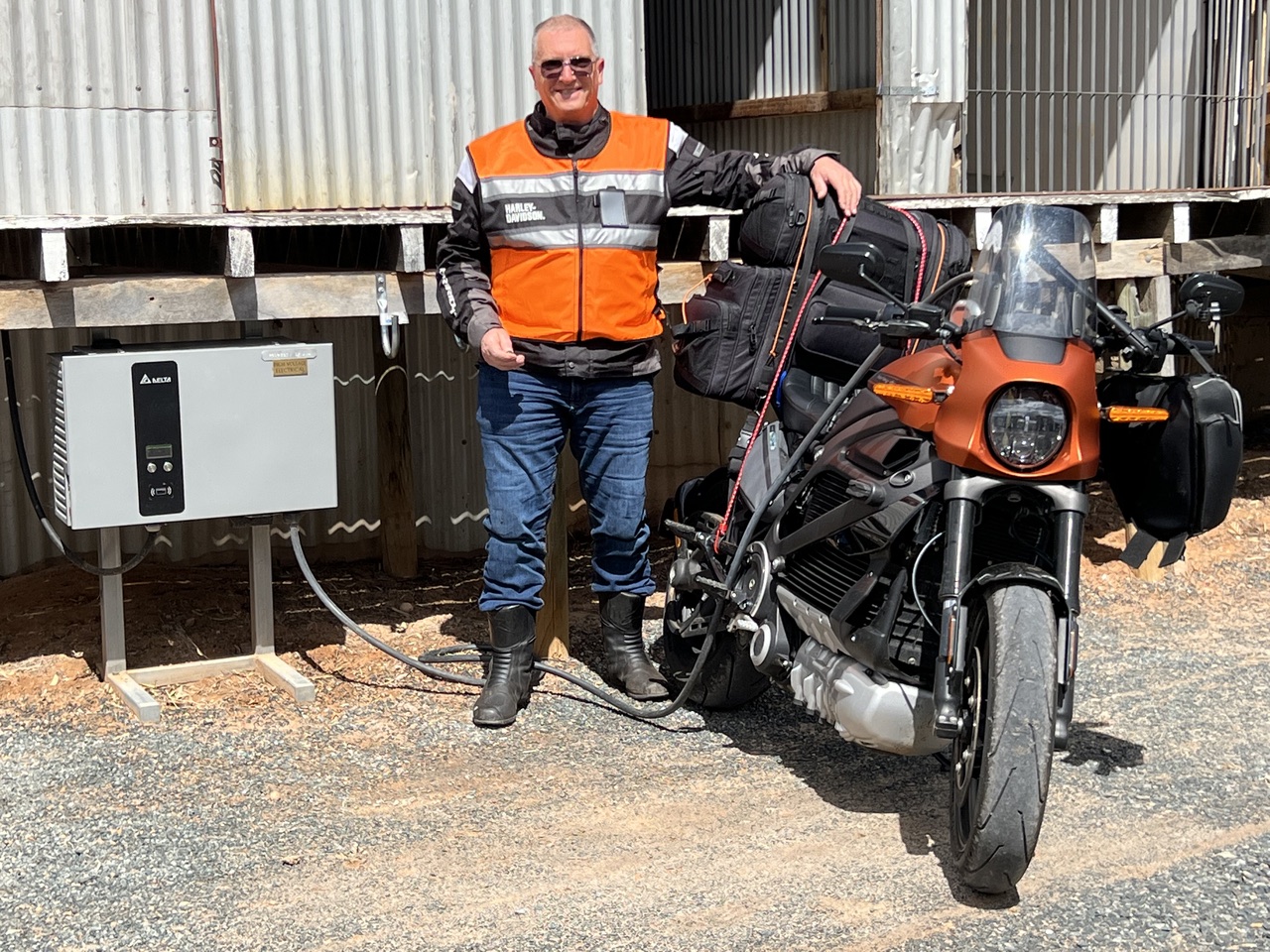
Along the way, Ed and Evan played the Nullarbor Links — the world’s longest golf course, one hole per roadhouse across the full 1,200 km crossing, on fairways of dry scrub and greens of marine carpet. A German couple they kept crossing paths with, Susi and Klaus, couldn’t get right-handed hire clubs, so Ed and Evan shared theirs — just two irons and a putter — with them for the rest of the crossing. It’s the kind of detail that belongs in a travel story; what belongs here is that the same roadhouses hosting those golf holes are the ones with the chargers, which means the charging network across the Nullarbor is, functionally, already embedded in the tourist infrastructure. The overlap isn’t accidental.
South Australia: Infrastructure Reality Check
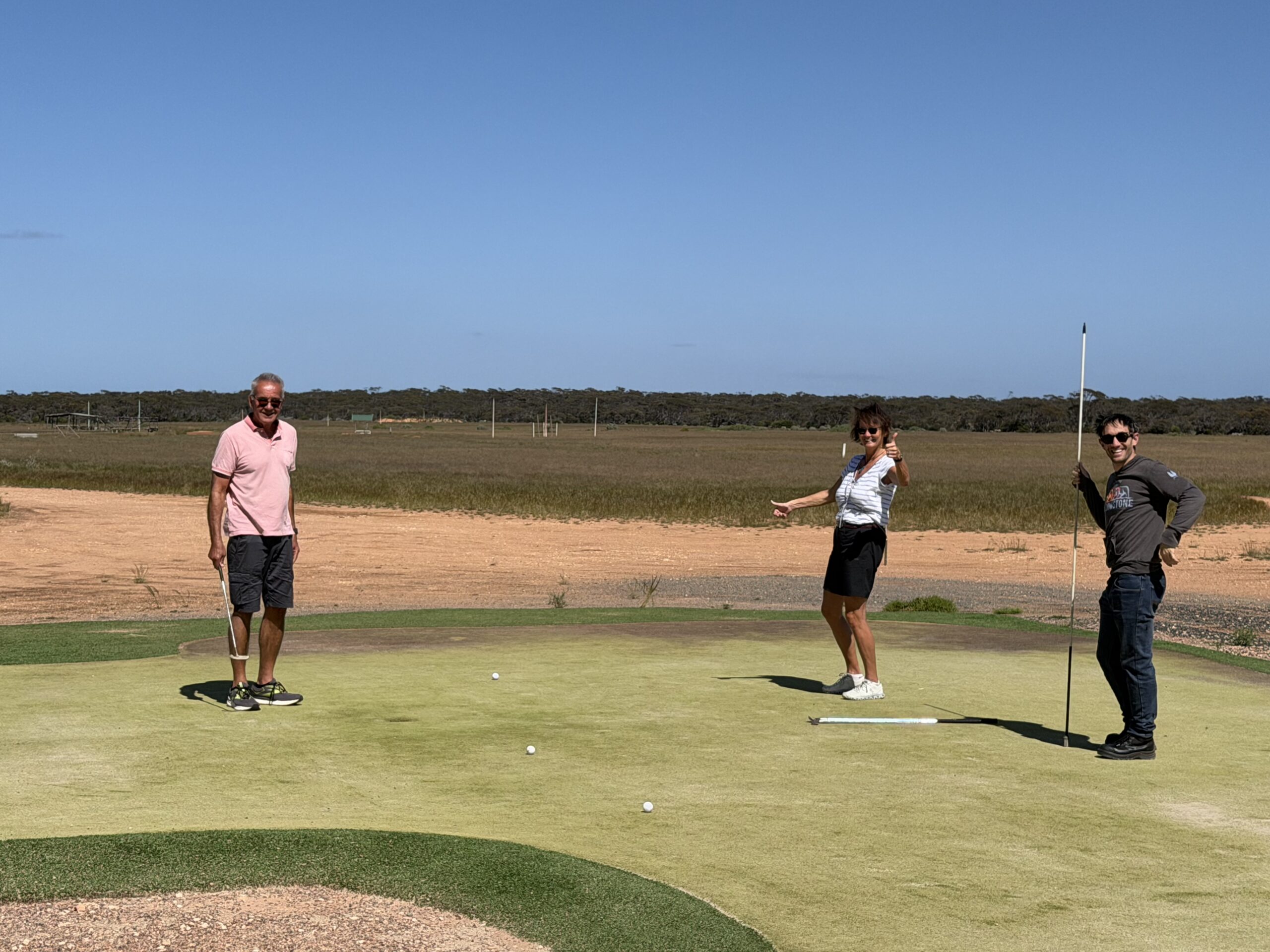
Through South Australia, the charging picture became more mixed. Ed revisited some of the same ground he’d covered during his 2022 LiveWire crossing, including a stop at Spalding Hotel where he caught up with people from that earlier trip — a small moment that underlines how quickly a niche community builds when the same routes keep producing the same conversations.
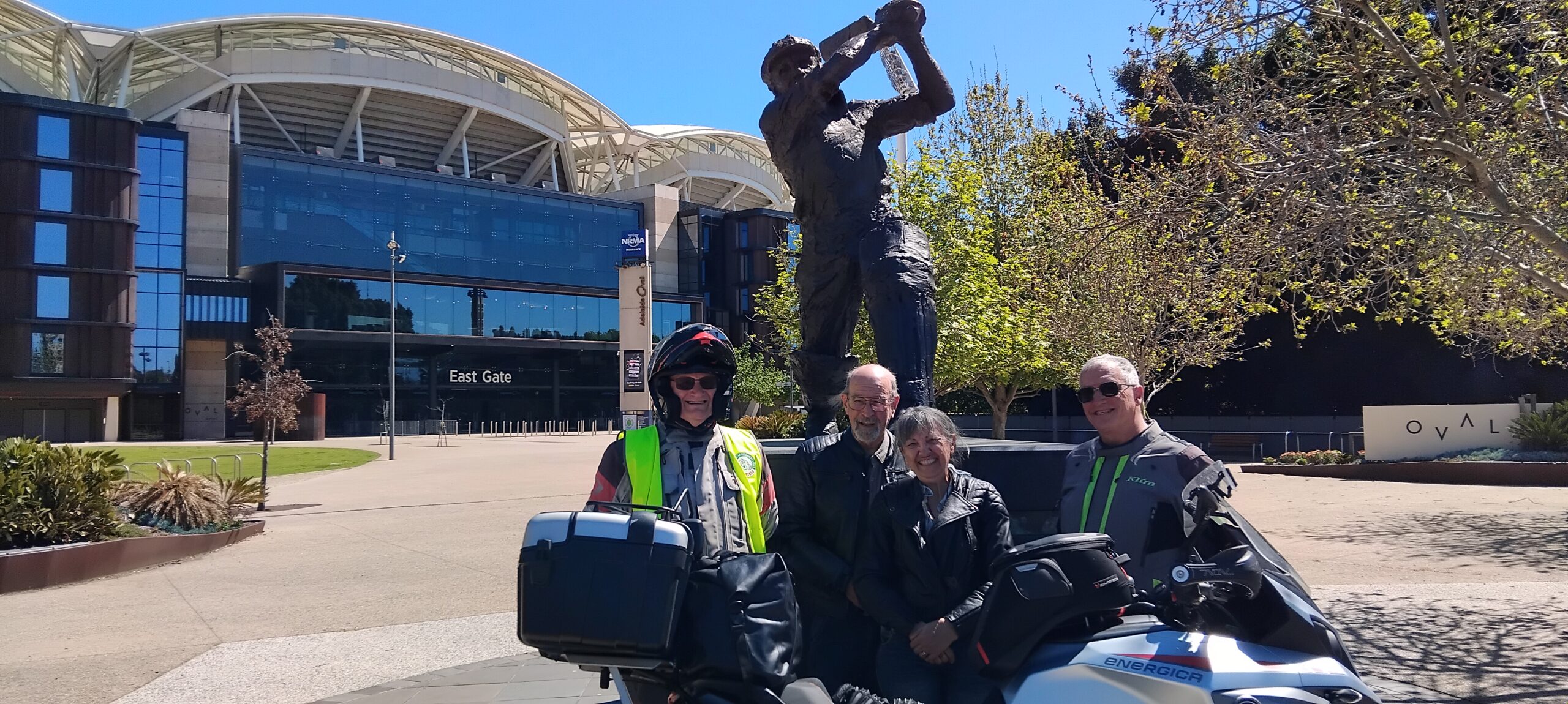
Adelaide’s MotoChat crew, off a live interview Ed had done with their Coast FM radio show, rode out on their own bikes to escort him into the city.
The Run Home: Company Joining the Last Few Hundred Kilometres
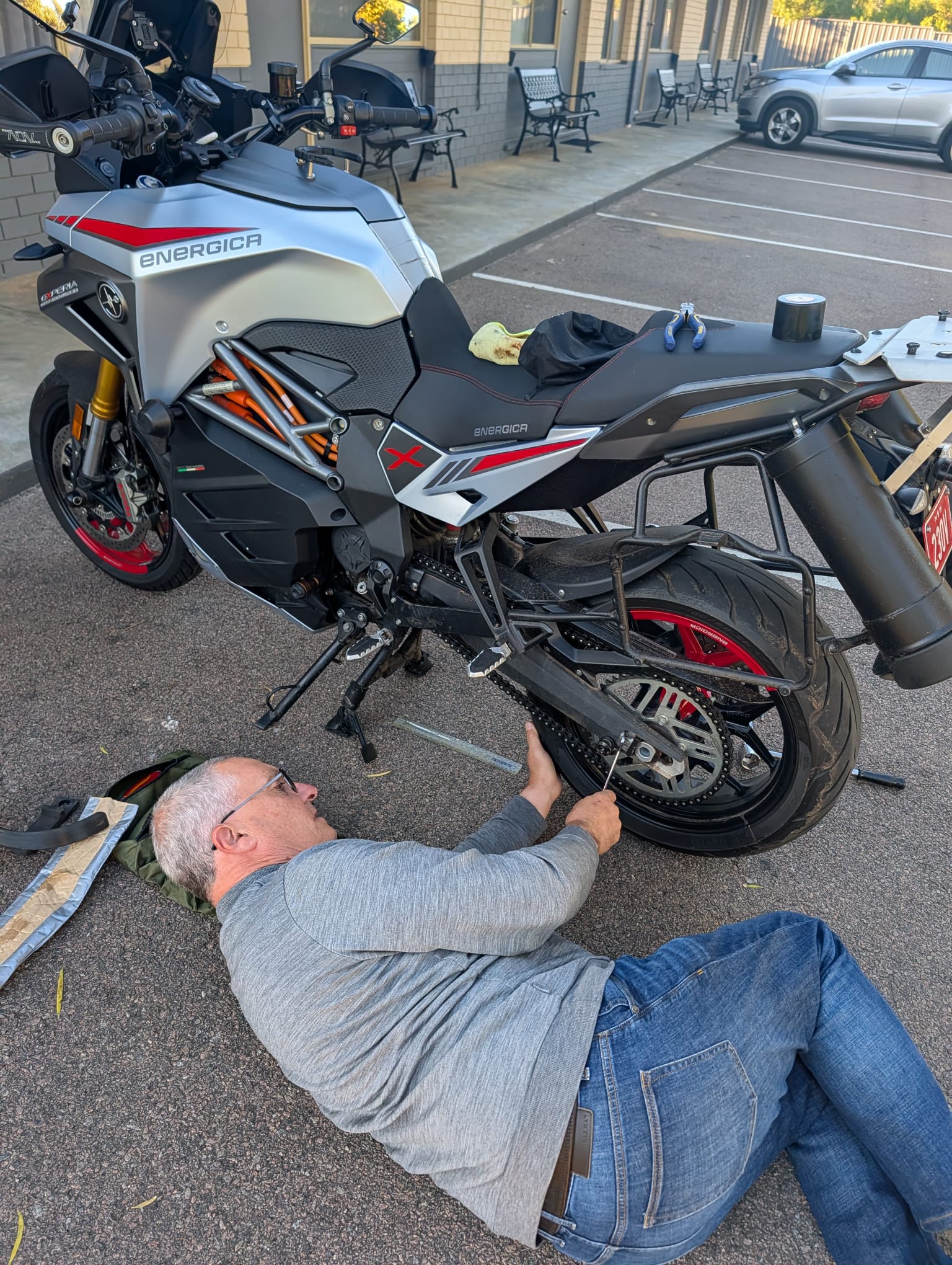
The closer Ed got to Sydney, the more company appeared. In the final stretch, riders and supporters joined at various points — dinner in Bega, more through Nowra, a mate on his own LiveWire following him home across the Harbour Bridge in torrential rain and fog. By the end, he was joking he’d turned into Forrest Gump — collecting running mates at every turn, and more than 1,300 of them on Facebook. Sally had a welcome party waiting.
It wasn’t the sunny finish you’d script for a promotional campaign. It was, as Ed put it, appropriate for how the whole trip had gone — real conditions, real infrastructure, real outcomes.
What It Means for the Infrastructure Argument
Ed’s own summary of what made the trip possible is worth quoting directly: it wasn’t speed or luck that got him around — it was understanding each leg before riding it, managing the range instead of fearing it, and treating every one of the 18,446 kilometres as something to actually engage with rather than endure. Twelve months of planning and three months of riding, on one bike, with no petrol stop the entire way.
For CleanTechnica readers, the more interesting question is perhaps what the trip demonstrates about the current state of Australia’s charging infrastructure. The honest answer is: it’s uneven, and the unevenness has a pattern. Urban and coastal routes are increasingly well-served. Remote corridors — the Gulf Country, the Gibb River Road approaches, the northwest WA coast — require careful planning and a tolerance for slow charges. But the gaps that existed are shrinking, and in several cases the EV charging network proved more reliable than the petrol supply in the same locations.
What Ed did wasn’t a stunt. It was a detailed demonstration that the infrastructure, the technology, and the planning methodology are all already there. The argument has been run over 18,000 kilometres of Australian road, anti-clockwise, with a pillion passenger for nearly half of it.
And a whole lot of fun for Ed. As he said: YOLO. You only live once, might as well enjoy it.
For those who would like to explore Ed’s coverage in the media, check out: ABC Digital; The Pack; Hungary’s Onroad (which not only followed the story, but is planning to do a followup article). There’s also interest from the UK’s Buck City Biker. The Cooldown picked up the ABC story, as did Channel ACB (Australian Ceylon Broadcast Sri Lanka) and Ride Asia.




Comments
No approved comments yet. Be the first to comment.
Leave A Reply