EU Biofuels Post-2030: Modelling Warns First-Generation Crop Biofuels Could Quadruple Land Use and Emissions
Summary
New scenario modelling examines how the EU's post-2030 Renewable Energy Directive could expand first-generation food- and feed-crop biofuels, potentially doubling or quadrupling volumes, land use and emissions by 2040. Researchers warn that weak caps risk climate, environmental and food-security harms, and argue scarce advanced biofuels should be reserved for hard-to-electrify sectors like aviation.
A deep-dive exploring the impacts of potential EU biofuels policy scenarios
The discussion around the future of the Renewable Energy Directive (REDIII) is underway as the European Commission devises what role renewable energy will play in transport in the post-2030 energy framework.
As the political priorities of the EU focus on energy independence and domestic industry, there is a renewed push for more first generation food and feed crop biofuels in the European transport energy mix. But these biofuels can have adverse impacts on the climate, environment and food supply chains.
To address these concerns, we have modelled three different policy scenarios to demonstrate the consequences of varying outcomes and their potential impact on the climate, environment and food security.
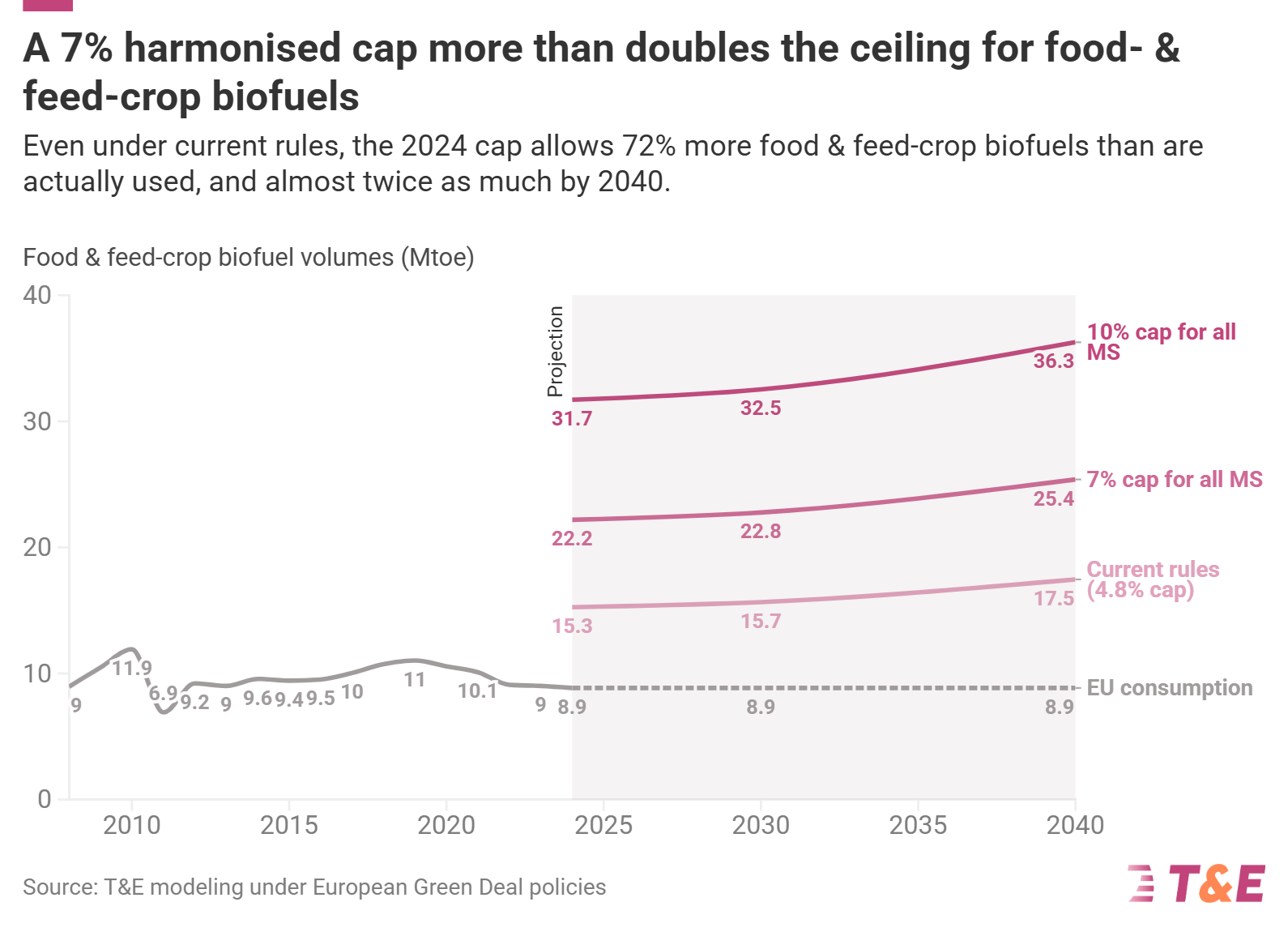
Our findings show that the current cap on first-generation biofuels set by the Renewable Energy Directive (RED III) can allow 72% more food- and feed-crop biofuels to be used in the EU transport energy mix, compared to what the bloc consumed in 2024.
When accounting for indirect land use change, even at current consumption, emissions from first generation biofuels already reach nearly 43 MtCO2e, about 23% more than the fossil fuels they replace.
When safeguards take the same form as stipulated in RED III and other key transport regulations, food- and feed-crop biofuel volumes, land-use area and emissions could all potentially double by 2040, emitting an equivalent to more than 5 million diesel cars.
In an unfavourable scenario, whereby the cap on first generation biofuels is harmonised at 7% across Member States’ transport sectors, volumes, land use and emissions would almost triple.
In a worst case scenario, where the cap on first generation biofuels is expanded beyond 7%, the negative consequences would be far heavier. We have used 10% as an example: volumes, land use and emissions could be four times today’s levels in 2040. Land dedicated to biofuels could reach 17.7 Mha, 18% of the EU arable land, an area larger than Greece, and emissions would exceed those of fossil fuels by 33 MtCO2e.
For advanced and waste biofuels, which are limited in supply, we show that the road sector is currently overconsuming available feedstocks, which should be directed towards sectors that cannot be electrified, particularly aviation. Furthermore, recent cases of fraud have highlighted the risks of relying on third country exports, making the case that all palm oil derivatives should be phased out and that effective safeguards should be put in place to allow for the most sustainable feedstocks.
Download the briefing.
Article from T&E.



Comments
No approved comments yet. Be the first to comment.
Leave A Reply