Sinopec Converts Shanghai Petrol Station to BYD Flash Charging Hub
Summary
Sinopec has transformed a former petrol station in Shanghai into BYD's first flash charging flagship station in East China, removing fuel tanks to install chargers with up to 1,500 kW output. This partnership supports BYD's rapid expansion of flash charging across China, with plans to build 20,000 stations by year-end.
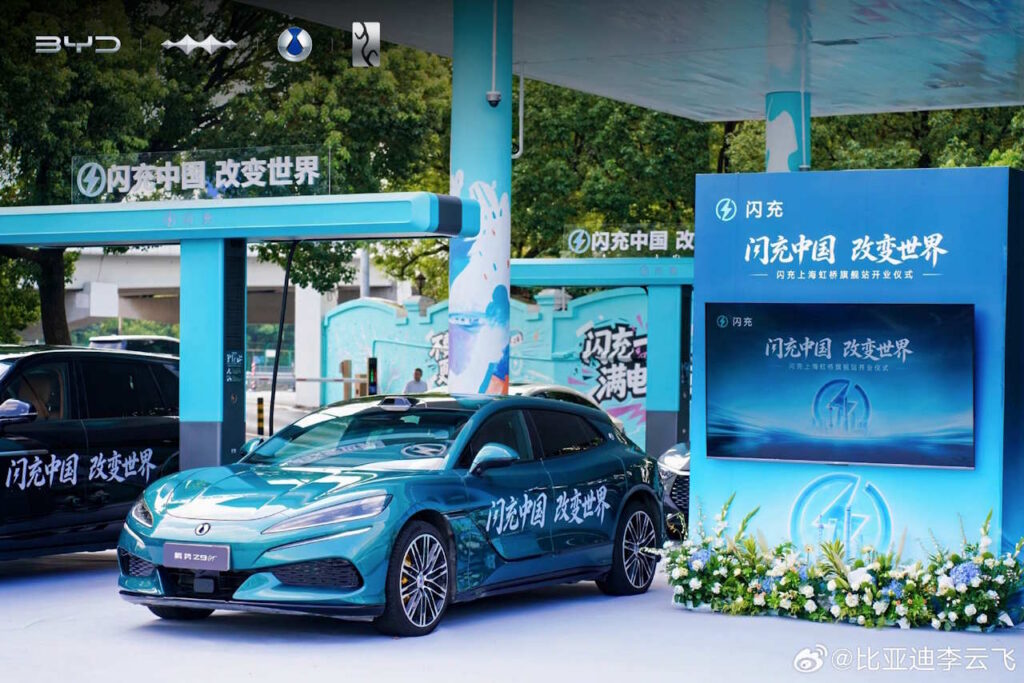
Chinese state-owned oil and gas giant Sinopec has completely gutted one of its petrol stations in Shanghai of its fuel infrastructure so that it could be converted into a BYD Ultra-Fast Charging Flagship Station.
BYD has been steadily building out its so-called “flash charging” stations and earlier this year launched its second-generation blade battery and flash charging technology which is capable of charging from 10 to 70 per cent in just 5 minutes, and from 10 to 97 per cent in 9 minutes.
The company also announced its plans to build 20,000 flash charging stations across China by the end of the year.
BYD signed a partnership in June with Sinopec to advance its charging strategy. The industrial and capital cooperation framework agreement was signed in Beijing on June 3 and will see the two companies collaborate on constructing a flash charging network, among other efforts.
And the first visible sign of this partnership has begun making the rounds of Chinese media, thanks in part to a social media post from BYD Group’s brand and public relations general manager, Li Yunfei.
According to Li Yunfei, BYD’s first “flagship flash charging station” in East China was unveiled last week and it was later revealed that the new charging station was a former Sinopec petrol station in Shanghai, adjacent to the Shanghai Hongqiao Transportation Hub.
Photos show the former Sinopec station operating with six T-shaped chargers, each with two charging cables that are capable of charging at up to 1,500 kilowatts (kW). Each charger is equipped with four blade batteries to act as grid buffers, with a total capacity of either 169 or 185 kilowatt-hours (kWh).
Various outlets have reported that Sinopec dug out the existing underground fuel tanks to make room for battery storage.


Comments
No approved comments yet. Be the first to comment.
Leave A Reply