Europe EV Sales Report: Record Month — BEVs Reach 30% Market Share!

Summary
BEVs jumped 51% YoY in an off-season month. BEVs remain in high demand in Europe, even in a holiday month, like August. This month, along with July, is unusual because in Europe, most makers and their models slow down their operations because of the holiday season, with the exceptions being … [continued]
BEVs jumped 51% YoY in an off-season month.
BEVs remain in high demand in Europe, even in a holiday month, like August. This month, along with July, is unusual because in Europe, most makers and their models slow down their operations because of the holiday season, with the exceptions being models in high demand, which profit from the slowdown and shorten waiting lists.
As such, it is natural that August was an especially strong month for BEVs, with pure electrics reaching a record 30% share last month thanks to some 250,000 fully electric vehicles being registered in Europe in August, which is not only a 51% increase year over year (YoY) but it is also the fastest growth rate this year!
Overall, plugin vehicles were up 39% YoY, dragged down by plugin hybrids, which grew only 15%, to 98,000 units, their lowest growth rate in 18 months, thus placing August’s plugin share at 42% (30% for BEVs only).
With BEVs pulling the market upwards, the year-to-date share for BEVs is at 24% (35% for PHEVs and BEVs combined), which is already higher than the 2025 final result (20% BEV share, 29% adding PHEVs). This is an encouraging sign if we want to be close to 100% PEV share by the mid-2030s.
Looking at other powertrains, while petrol (18% share in August, down 24% YoY) and diesel (6%, down 23% YoY) continue their downward trend into irrelevance, the main news is the fact that we might have passed Peak HEV at this point — in August, plugless hybrids still grew, albeit less (+3% YoY) than the overall market.
More important than that, if we compare the 32% share earned by HEVs in August 2026 with the share they had 12 months ago (33% then), we might be witnessing the beginning of plugless hybrids’ downward slope. So … if 2026 is the year of Peak HEVs, how far are we from Peak PHEVs?
Speaking of PHEVs, let me highlight these two graphs, which document the evolution of BEV and PHEV sales by production origin over the past few years, and the importance that EU tariffs had on them.
As we can see in the BEV graph, the EU tariffs on Chinese BEVs, enacted in the second half of 2024, kept the Made-in-China models more or less at the same share they were at before the tariffs. True, in absolute terms, Chinese BEVs kept growing to record levels, but approximately at the same pace as the overall BEV market, as pure electrics earned an increasingly larger share of the overall market.

On the other hand, Chinese PHEVs, which in 2024 represented only 10% of the total number of PHEVs sold in Europe, a share significantly smaller than the 23% that Chinese had of the BEV market at the time, now have 28% of the PHEV market in Europe, clearly surpassing Made-in-China BEVs (21%) in that metric.
What has happened for such a seismic change in just two years? EU tariffs. While Made-in-China BEV sales were being dragged down by the weight of tariffs, PHEVs were not, paying only the original 10% tariff.
So, what have Chinese OEMs done? They’ve gone for the loophole and invested heavily into PHEVs, like the BYD Atto 2 PHEV, Geely Starray, Jaecoo 7 PHEV, Omoda 9, etc. And sales boomed.
This year alone, against an overall moderate sales growth environment for PHEVs (+24% in 2026), Made-in-China plugin hybrids are growing … 141%!!!
On the flipside of this number, Made-in-Europe plugin hybrids are up … 3% this year. And have seen decreasing sales in three of the last four months. The trend is clear — Made-in-Europe PHEVs are facing extinction, not because people are moving into other powertrains, but because they are switching to Chinese ones.
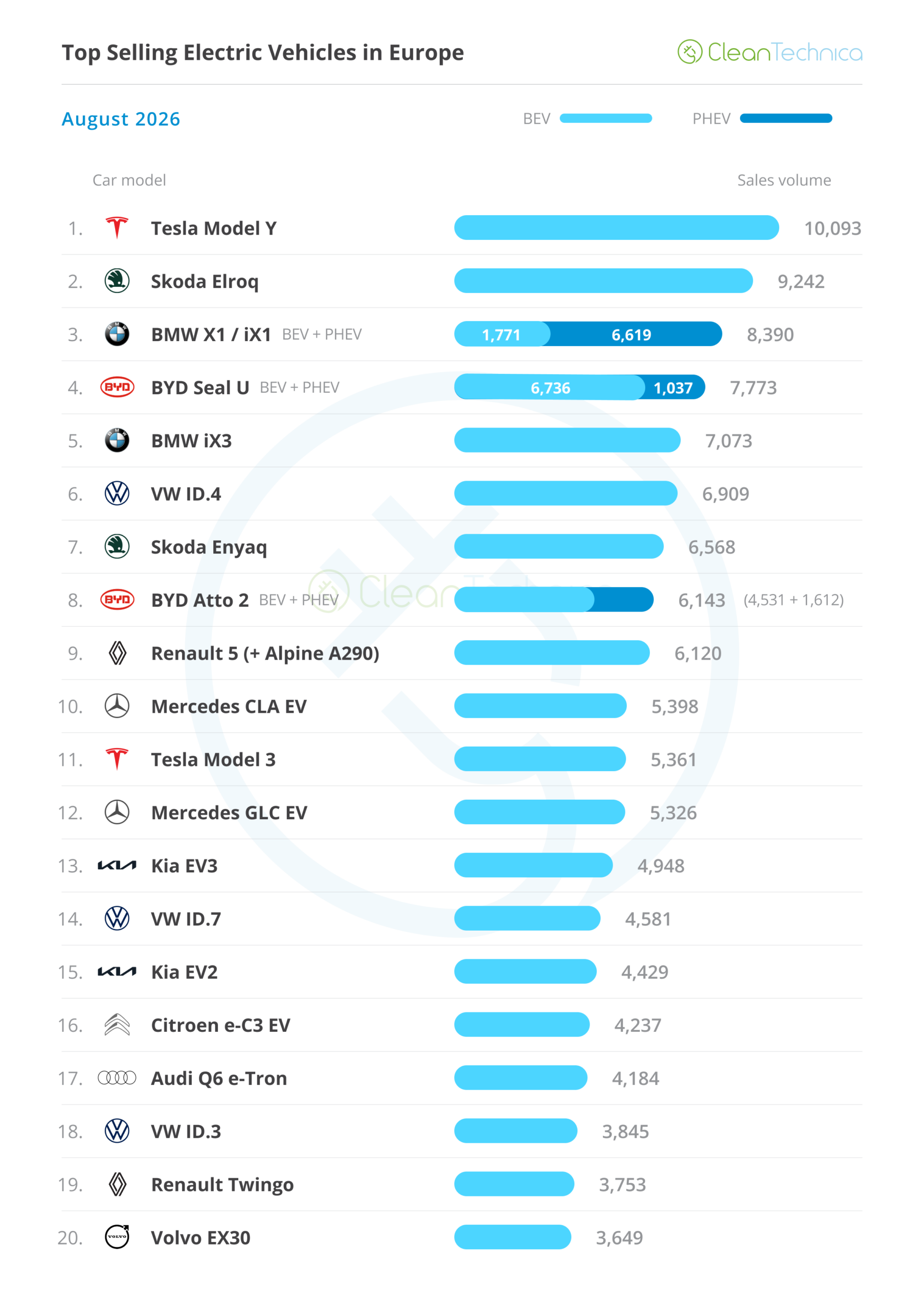
Looking at August’s best selling EV models, the big news this month was the Tesla Model Y returning to the top, as well as BMW placing two models in the top 5! The BMW iX1/X1 PHEV twins were in third, and the hot new iX3 SUV jumped into 5th. Here’s a more detailed analysis of the top 5 EVs in August:
#1 Tesla Model Y — Tesla’s midsize crossover is back in the driver’s seat, thanks to 10,093 registrations in August, a 21% increase YoY. With Model Y prices starting at €40,000, and even after six years on the market, the crossover still offers an appealing package. Currently, you buy a Tesla with your wallet/head, not your heart. Which is exactly the kind of buyer that is now searching for EVs. Many of these people simply want to lower their running costs by switching from ICEVs to BEVs. (Also, it’s why they are so popular with Ubers and such.)
#2 Skoda Elroq — The Elroq continues surfing the BEV wave, with 9,242 registrations, a 45% increase year-on-year. Looking ahead, the Czech crossover will have to face fierce internal competition, as the new, smaller, and more affordable Skoda Epiq crossover is about to land. Being simultaneously cheaper and more modern than the Elroq, will the Epiq become Skoda’s new best seller at the cost of the Elroq?
#3 BMW iX1/X1 PHEV — The German twins are in cruise control, winning another podium presence in August thanks to 8,390 registrations. Benefitting from favorable lease rates to help things along, the BMW crossovers are the brand’s bread and butter models. With a deep refresh coming to BMW’s compact models later, promising to transform them into baby Neue Klasse vehicles, expect both, but the iX1 in particular, to upgrade their specs. That will make them more interesting than the current versions and allow the Bavarian brand to keep its compact models as podium material.
#4 BYD Seal U (BEV+PHEV) — The Chinese SUV remained in the top 5 and hit 7,773 registrations last month, meaning that while the BYD’s star is recovering in China, thanks to its new-generation Ultra body, the old generation is still able to reach the top 5 in Europe all by itself (a bit like when veteran football/soccer players leave top leagues and semi-retire in less competitive ones…). August’s 4th place finish was much thanks to generous discounts, but still, with the model’s development costs now well behind it, BYD can afford to go into hard discount territory with this one.
#5 BMW iX3 — The Best BEV Sold By An European OEM. Period. While BMW’s management isn’t that all-in on EVs, their engineering department is, and it created a model that jumped two generations ahead of the competition, for once justifying the price premium associated with the Bavarian brand. Launched with class-leading specs (108 kWh battery, 400 kW charging, V2X capability), which translated into an outstanding range (and efficiency), BMW added its usual world class handling DNA and innovative interior to offer something that the competition (even the Chinese) still has to catch up to. As a cherry on top, even the overall design is not divisive, as it was with past BMWs. BMW has shown other European OEMs how to adapt to the new times — having learned valuable lessons from the original 2020, Made-in-China iX3, it set to create a replacement model that was not only competitive in 2026, but in the years to come as well…. Oh, I almost forgot — the iX3 was 5th in August, thanks to 7,073 registrations.

Outside the top 5, there were a number of highlights to mention.
Starting with Mercedes, we have another strong result from the Mercedes CLA EV (10th place with 5,398 registrations), but the real news is the 12th position of the new Mercedes GLC EV, thanks to a record 5,326 registrations. One wonders if the midsize SUV is close to reaching its cruising speed or if there will be even higher volume months ahead.
Regardless of what might happen to GLC, I am now curious to see whether the Mercedes will be able to come close to the BMW iX3’s volumes. I mean, the three-pointed-star model’s specs are a degree below the Bimmer’s, but on the other hand, its interior does look more appealing. And a lot of people love the design of the GLC.
Good news also in the Kia stable: Its star player, the EV3, continues to feature in the top 20, this time in 13th, but even better than that, the highlight in August was the new EV2 small crossover (it’s basically a hatchback on stilts, but anyway … marketing oblige). The EV2 joined the table for the first time thanks to a record 4,237 units. With production still in ramp-up mode and a sizeable waiting list, the EV2 looks destined to become the automaker’s best seller in Europe.
Finally, a reference is due for Citroen. The 4,237 units delivered of its C3 EV small hatchback were not only its best score in five months, but allowed the French automaker to once again make something that seems to be elusive to the remaining Stellantis brands — selling a model in enough volume to reach the top 20. Maybe the new 2027 Peugeot 208 EV will help change Stellantis’ fortunes? One thing is certain: They really, REALLY need a hit.
Outside the top 20, the highlights come from Volkswagen Group’s new small EV family. The sporty Cupra Raval hatchback (3,608 units) is close to joining the table, having ended the month at #21. As the production ramp-up evolves, expect the spicy Spaniard to join the table soon. As for the more grown up VW ID.Polo, it had its debut month in August, an already solid 1,876 units delivered. A lot of expectations are on its shoulders, especially now that Volkswagen is seeing ICE orders drying up in the market and BEV orders exploding. According to reports, the new ID.Polo already has a waiting list of up to 10 months….
Maybe VW could expand production by allocating part of the ID.Polo production to one of its underused German plants?
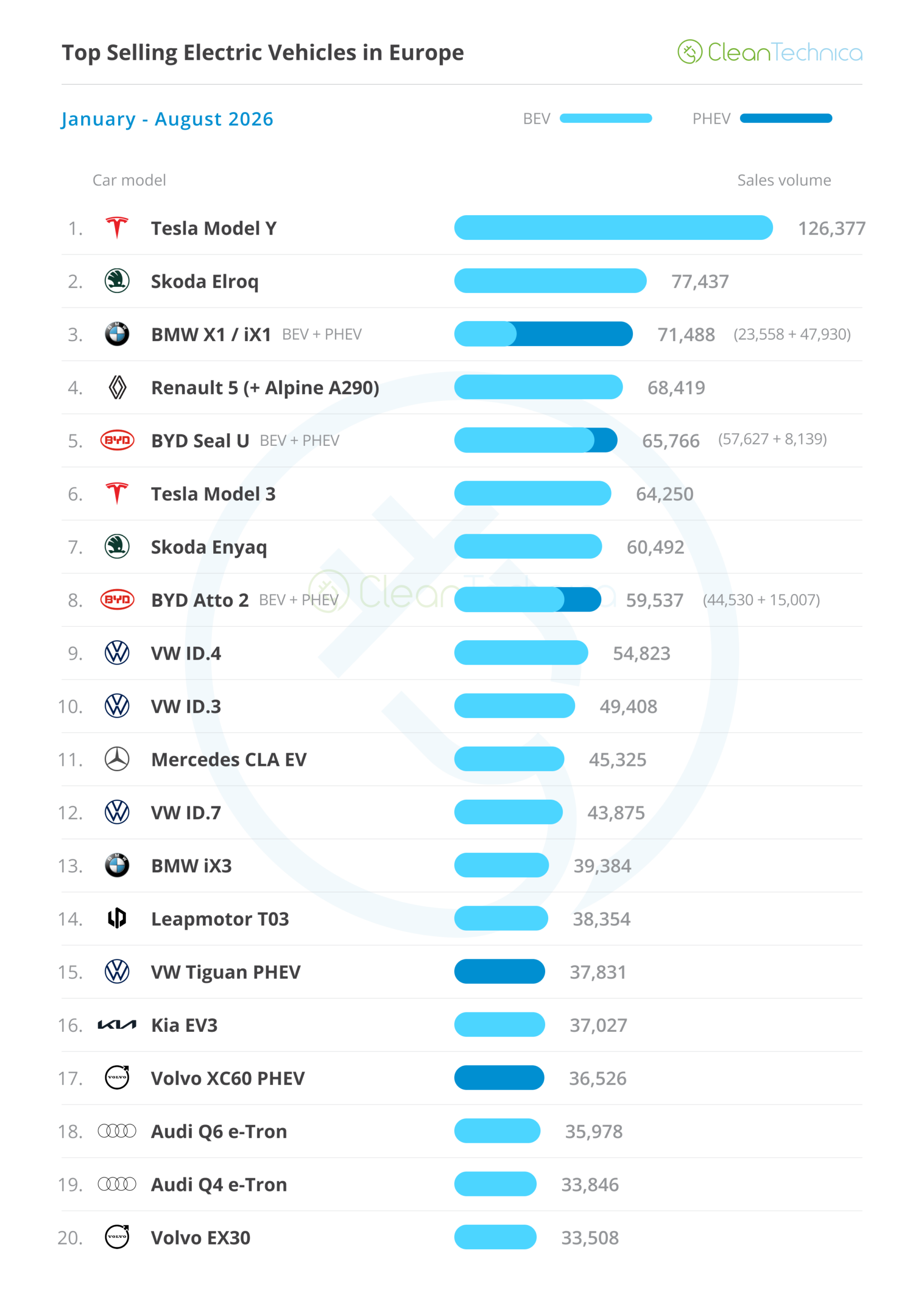
Looking at the 2026 ranking, the only change in the top positions was the BYD Seal U surpassing the Tesla Model 3 and rising up to the 5th position, pulling the US sedan to 6th. Still, with September right around the corner, expect the Model 3’s high tide in the last month of the quarter to bring it to higher standings, with the question being — how high? The #2 spot now seems unlikely, as the Skoda Elroq looks too far ahead to be bothered, even if the Skoda Epiq starts to steal sales from it. As for the #3 spot, I would say there’s a 51% probability the BMW twins to keep the bronze position. They have been consistent throughout the year, so they might have a slight edge over the Model 3. Regarding the 4th position, I would say that the Tesla sedan has some 80% chance to surpass the Renault 5 and only a big surprise could allow the French hatchback to stay in 4th.
Bring on the popcorn, because this looks to be fun!
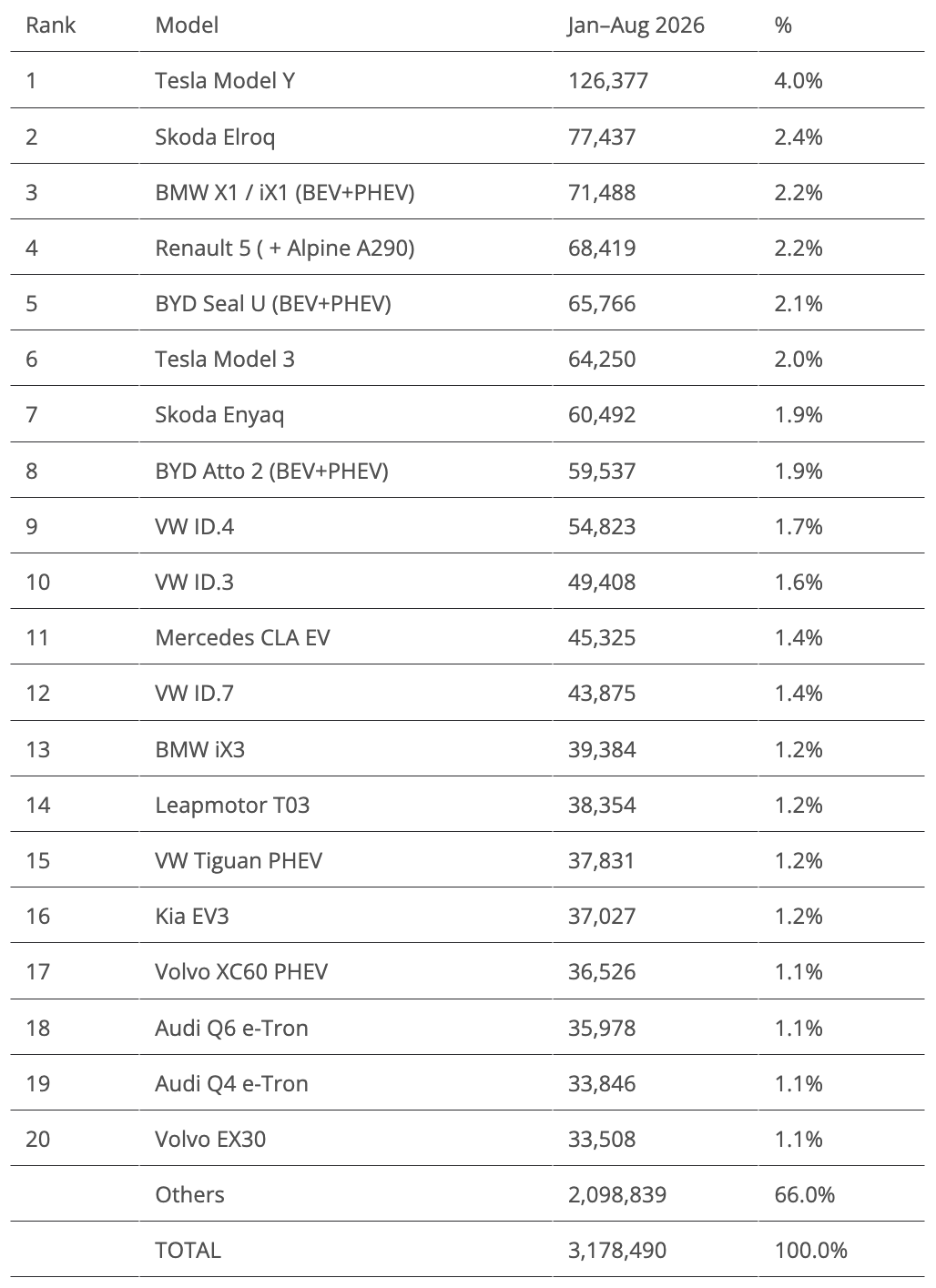
As for the remaining changes, the BMW iX3 jumped three spots, to 13th. How high will the German SUV go? I would say 12th in September is likely, 11th in a few months, and maybe it can even have a shot at 10th in December? Please place your bets!
Finally, benefitting from a weak month from the Volvo XC60 PHEV, the Kia EV3 climbed one position, to 16th. And considering the current (slow) selling moment of PHEVs, the Korean crossover could have a shot at surpassing the VW Tiguan PHEV in September and threatening the #14 spot of the Leapmotor T03.
Having a quick look at the overall brand ranking, the highlights were the contrasting fortunes of Hyundai (12th, with 26,186 units, down 30% YoY), and Kia (7th, with 36,810 units, up 16% YoY), as well as the usual rise and rise of the Chinese brands.
BYD, also known as the Chinese Toyota, ended the month in 13th, with 26,090 units, ahead of mainstream staples like Opel (14th), Citroen (15th), and the (once) disruptive mega-brand Tesla (19th).
But the strength of the Chinese automotive industry is the fact that it doesn’t rely on one major OEM, but rather the diversity it offers to European buyers — China has 15 brands in Europe’s top 50! Of them, the highlights are the surging Jaecoo (#24, +191%), Omoda (#27, +129%), Leapmotor (#29, +222%), and Xpeng (#31, 323%).
(One could say that the overall European market is growing — +5% YoY — thanks to the rise of Chinese OEMs….)
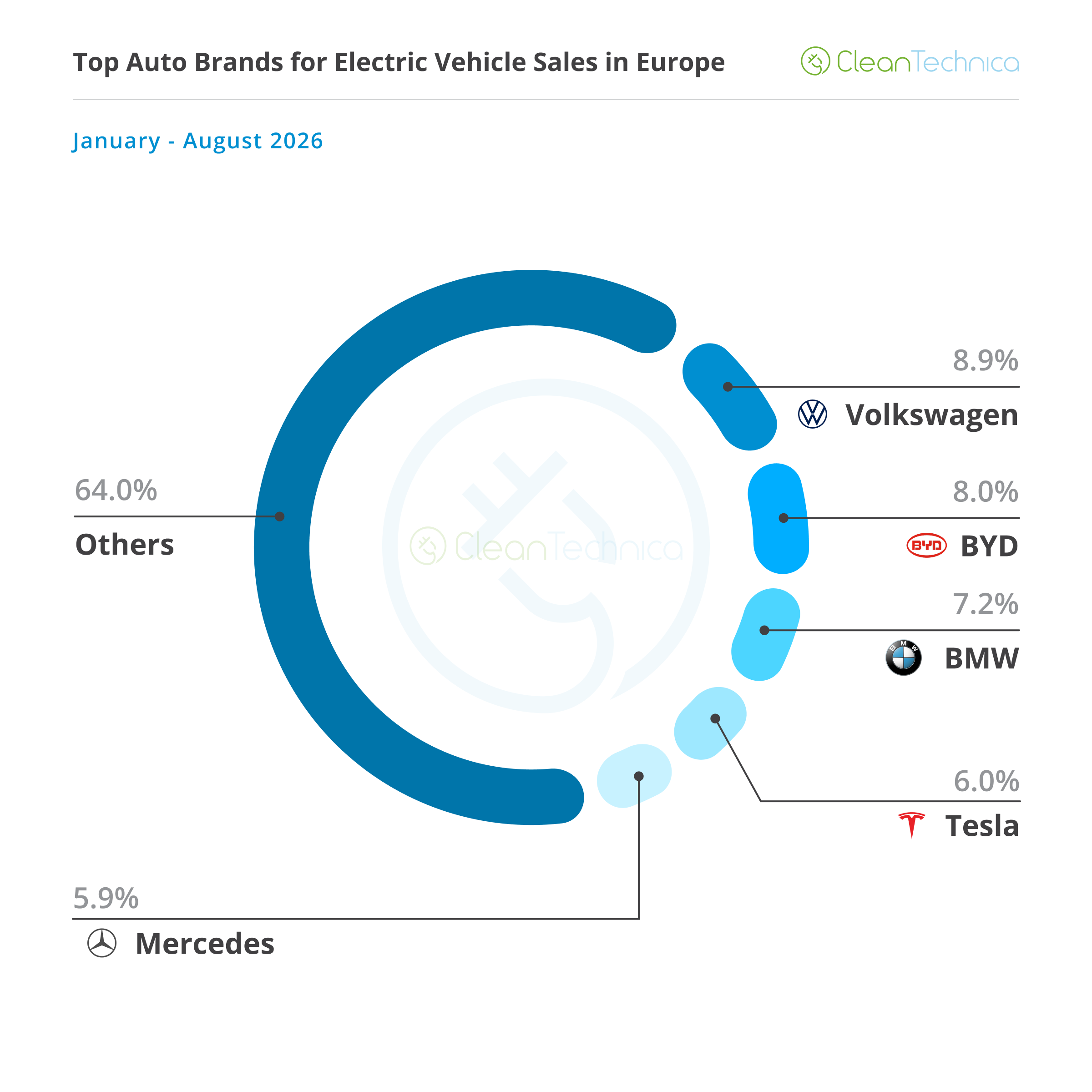
As for the plugin auto brand ranking, the leader, Volkswagen, remained in the lead, although it lost some share (8.9%, down from 9% in July and down from 9.3% in May). Sure, it still holds a comfortable advantage over a rising BYD (8%, up 0.1%), and its new EVs (VW ID.Polo, ID.Cross, ID.Tiguan, etc.) should help it recover some sales, but … the German brand cannot allow itself to slow down. It can’t distract itself by hoping for some kind of ICE recovery/miracle. If it does, the company will get BYD on its back real fast … in its home market. And if you can’t win at home.…
BMW (7.2%, up 0.1%) is stable in the last place on the podium, and although it won’t be able to retain the silver medal (which it won in 2025), since BYD is simply playing in a different league right now, the Bavarian brand should end the quarter ahead of Tesla (6% share, down from 6.2% in July), which would allow it to score its 10th podium presence in the last 11 years.
It will be an interesting race between these two for the bronze medal until the end of the year.
In 5th we have Mercedes (5.9%). It is holding steady in the last position of the top 5 and even gained a little bit more distance over #6 Audi (5.4%). The Ingolstadt make now has its Czech cousin Skoda closer than ever (7th, 5.3%).

Arranging things by automotive group, Volkswagen Group is firmly in the lead, with 23.9% share. With plenty of fresh metal coming soon, expect the German OEM to stay comfortable in the lead.
#2 BMW Group (8.7%) continues to consolidate the runner-up spot, while #3 Stellantis is consolidating … its never ending slide (8.1%, down 0.1%). The multinational OEM’s drops seem to have no end in sight, and it could even lose its podium position this year, as 3rd placed BYD (8%, up 0.1%) is getting closer every passing month. Could this change happen already by September?
Interestingly, both BYD’s rise and Stellantis’ fall are almost a mirror of each other, so maybe the Shenzhen’s rise in Europe is being mostly coming at the expense of Stellantis? Something to think about….
Outside the top 5, #6 Geely (6.8%, down from 6.9% in July) lost ground to #5 Hyundai–Kia (7.5%). And with the 7th placed Renault–Nissan Alliance starting to show up on the radar as well, there could be an interesting race for the 6th position.



Comments
No approved comments yet. Be the first to comment.
Leave A Reply