It’s time to revisit the cash for clunkers idea – but in a way that makes it fair on households
Summary
Australians driving older petrol and diesel vehicles often pay the most at the bowser, spend more on repairs and rely on cars with the weakest safety equipment.
Australia should revisit the old “cash for clunkers” idea – not as a blunt subsidy for anyone buying a new car, but as a targeted scheme to retire the oldest, least safe and most fuel-hungry vehicles, and help the people still driving them move to affordable electric transport.
The case for a targeted internal-combustion-engine vehicle-retirement program in 2026 is not that electric cars need rescuing. They do not.
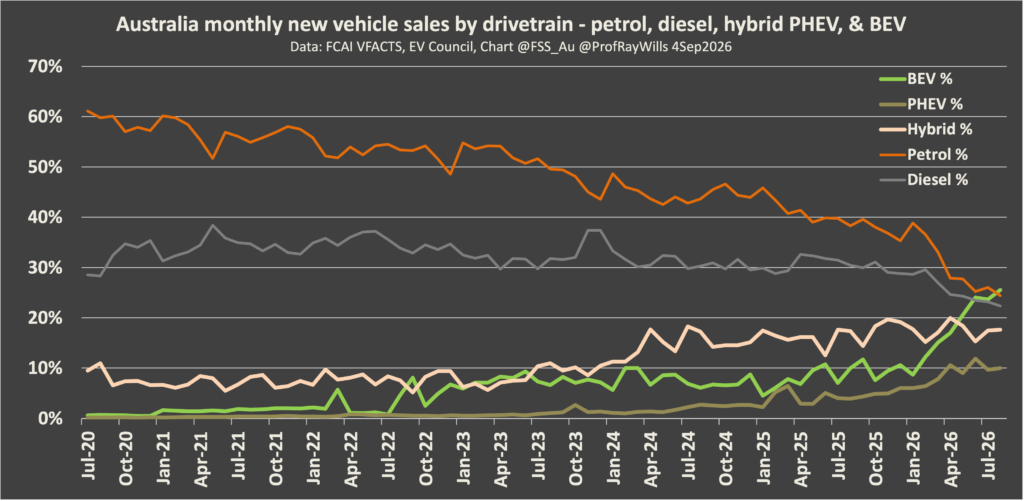
EV sales are rising strongly, with battery-electric vehicles now accounting for around one quarter of new vehicle sales in recent months.
But this is not fundamentally about cars. It is about us.
Australians driving older petrol and diesel vehicles often pay the most at the bowser, spend more on repairs and rely on cars with the weakest safety equipment. They may be driving an old car because it is what they can afford, not because it is what they want. That should concern a government focused on cost of living, health, safety and wellbeing.
For many households, an EV’s lower fuel and maintenance costs would be genuinely valuable. But the purchase price, lack of affordable finance and absence of accessible charging – especially for renters, apartment residents and households without off-street parking – can keep the transition out of reach.
Figure 1. Australian monthly new vehicle sales by drivetrain show a shift away from liquid fuels to electrification.
A modern program should address that gap directly.
Retire vehicles that are still used
The policy should not pay people to scrap vehicles already destined for the wreckers. Public money should be directed only to cars that are actively registered, roadworthy and demonstrably still in service.
Eligible vehicles should be continuously registered for a defined period before application, then permanently de-registered, VIN-recorded and dismantled through an accredited recycler. Without those safeguards, a “clunker” payment could merely shift an old vehicle to another owner—or export its emissions and safety problems elsewhere.
The program should target vehicles that deliver the greatest public benefit when retired: older, high-emitting and fuel-hungry cars, particularly those driven substantial distances. It should also recognise safety.
Replacing a 20-year-old vehicle with no contemporary crash protection, no autonomous emergency braking and poor fuel economy creates more than a carbon benefit. It can reduce household transport costs while making roads safer for drivers, passengers, cyclists and pedestrians.
Road safety is not simply an aspiration. Governments routinely account for the economic value of avoided deaths and serious injuries when assessing public investments and regulations. A safer modern replacement vehicle can therefore produce measurable social benefits alongside lower emissions and reduced fuel use.
Safer, electric and cheaper
A 2026 program should be BEV-first and include used EVs. Restricting support to new vehicles would mainly assist buyers already able to finance a new car. The social value lies in helping lower- and middle-income households access a reliable used battery-electric vehicle with transparent battery-health information, transferable warranty arrangements and meaningful consumer protection.
This is where Australia’s transition is beginning to change shape. New EV sales are creating the fleet turnover that will eventually supply a larger, more affordable used-EV market.
But that market needs policy support.
Buyers need access to finance, confidence in repair services and reliable information about battery condition. Battery state-of-health can be assessed more transparently than many buyers assume, provided there is a recognised testing method and a clear disclosure standard. That will help ensure used EVs are seen as practical, dependable vehicles rather than an unknown risk. And the cheapest new car available in Australia is now also 100% electric!
Government and business fleets have a central role. Fleet vehicles turn over more rapidly than household cars. If governments, councils and large businesses electrify suitable cars, vans and service vehicles, they can create a pipeline of three- to five-year-old EVs for the used market. That matters far more than simply announcing another target.
Make use of the existing wheel
Australia already has part of the policy architecture. The New Vehicle Efficiency Standard began in 2025 and is pushing manufacturers to supply more low-emissions vehicles and more choice to Australian consumers. But it applies only to new vehicles entering the market. It does not directly address the old, high-emitting vehicle fleet already on the road.
Charging investment is also progressing. The Commonwealth’s Driving the Nation Fund supports charging infrastructure, fleet transition and related initiatives, while newer programs are intended to expand public, kerbside and fast charging options.
Critics will argue a rebate alone is not enough.
Some Australians cannot install a charger because they rent, live in an apartment, park on the street or face strata restrictions. Others cannot qualify for a conventional vehicle loan, even with a sizeable rebate. A policy that primarily helps people who can salary-package a new EV or secure a large loan risks widening the divide between households benefiting from electrification and those left paying petrol prices.
A package, not a cheque
A serious “retire and replace” program should combine:
- A point-of-sale scrappage credit for eligible high-emitting vehicles.
- Higher support for low-income, regional and high-kilometre households.
- Eligibility for certified used BEVs, not only new vehicles.
- A price cap and efficiency criteria to avoid subsidising expensive, oversized vehicles.
- Concessional finance or loan guarantees for credit-constrained households.
- Battery-health disclosure, warranty and consumer-protection standards.
- Support for home, apartment, workplace and community charging.
- Public-transport credit, car-share membership or other mobility support for households that do not need a replacement car.
There is also an electricity-system opportunity. EVs are not simply replacements for petrol cars; they are flexible electricity demand. Smart charging can shift consumption into periods of abundant solar generation. Fleet depots, workplaces and homes with solar and batteries can lower operating costs and make better use of low-cost renewable electricity.
Australia does not need a nostalgic cash-for-clunkers scheme. It needs a targeted, economically sound and socially fair program that retires genuinely high-emitting and less-safe vehicles, helps households burdened by fuel and repair bills, builds confidence in the used-EV market and makes charging accessible.
Done badly, it would be an expensive new-car subsidy. Done well, it could deliver cost-of-living relief, safer roads, lower emissions and a practical next step in Australia’s transport transition.


Comments
No approved comments yet. Be the first to comment.
Leave A Reply