Trump's Iran War and the Shift Toward Elastic Oil Demand: What It Means for Green Mobility
Summary
Eight months into Trump's war on Iran, the conflict appears to have triggered a seismic shift in global oil markets as demand becomes elastic for the first time. The emerging dynamics could reshape the economics of electric vehicles and accelerate the transition away from oil.
Almost 8 months into Trump’s war on Iran, we can see more clearly the consequences of this quagmire. Some have been quite unexpected, like the surprising resilience of the oil market, the emergence of multiple failure points outside of Hormuz (including Bab-al Mandeb, the East-West pipeline, and global refinery capacity), and the increased risk of regionalization for the conflict. These issues have no doubt taken a lot of analysts by surprise.
Others, like Trump’s reluctance to admit he messed up, have been quite expected.
But today I want to talk about something else. I believe this war has either caused or displayed a seismic change in the way global oil markets work. I believe that for the first time since oil is a thing, oil demand is becoming elastic.
And since so far I haven’t seen anyone make this claim, I wanted to put my hypothesis up for debate.
A Tale of Demand
When speaking about demand, economists normally use the terms elastic and inelastic to determine how much consumption will fluctuate when prices go up or down.
Some things, such as food staples, are consumed at quite stable levels. People will keep eating roughly the same regardless of their economic situation (unless very, very dire), and likewise, people who become wealthier are unlikely to eat much more: someone who just got a job paying double is not going to suddenly buy twice as many potatoes. This means that food demand is considered inelastic. Keep in mind this works the other way around: if potatoes suddenly halve in price, it’s unlikely that someone will suddenly start eating double the amount of them.
Other things, such as plane tickets, are more dependent on their price and the disposable income of consumers. People who suddenly get a better job at very likely to take a more expensive vacation or choose to fly instead of driving (or taking a bus) to save some time. Likewise, if plane tickets become cheaper, more people will choose to fly, and they will fly more often. Because of that, plane ticket demand is considered elastic.
(I apologize to all the economists reading this if my examples are too simple or otherwise dumb, but these were the best ideas I had in mind.)
For a very, very long time, oil demand has been considered inelastic. Since people need to commute to their jobs, visit their relatives, and move products around regardless of income or oil prices, oil consumption has remained roughly constant (with a tendency to increase over time), with demand increasing a bit faster if oil is cheap and a bit slower if oil is expensive. In this context, oil demand has historically required an economic crisis to go down: either the economy slows down for unrelated reasons and oil demand falls with economic activity generally (as happened during the 2008 subprime crisis), or oil prices go up so much that they cause a recession, only falling back down again through reduced economic activity (as happened during the 1973 and 1979 oil crisis).
But our world is changing, and I have reason to believe that oil demand is falling more and more into the elastic part of the equation.
To get to this conclusion, though, we first have to look at the current state of the oil market.
A messy, declining market
Out of the three main institutions following the global oil market (OPEC, IEA and EIA), two -the EIA and IEA- project a decline in global oil consumption of over 2 million barrels a day (mbd) whereas the third -OPEC- projects a slight increase. It goes without saying that I trust much more in the first two, as OPEC tends to be a bit… ahem, “optimistic” when it comes to the future of oil.
But I digress. The point here is that, according to the most reliable sources around, global oil consumption will fall by between two and three million barrels a day in 2026, a first since the pandemic years.
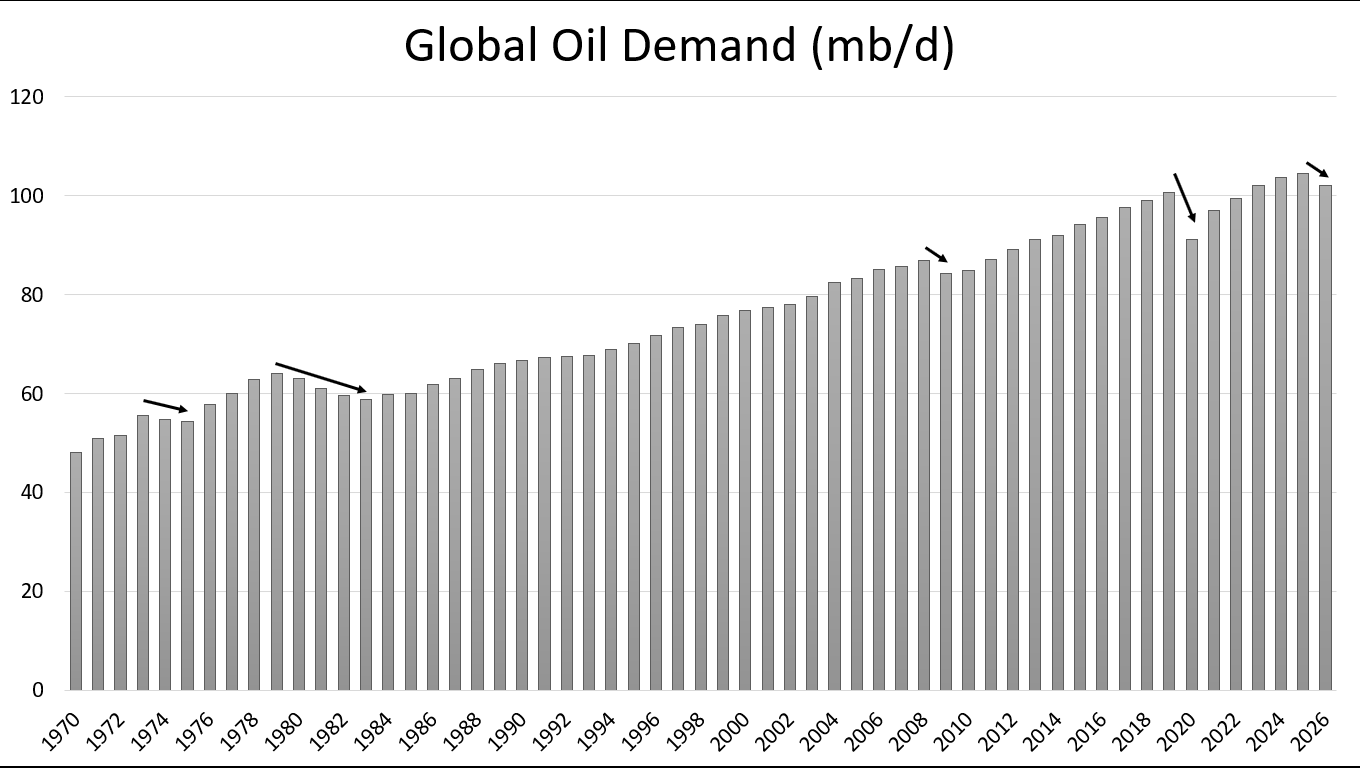
By itself, this is already incredibly relevant. This is the first time since ever that we’re seeing oil demand falling absent a generalized economic crisis or otherwise some sort of catastrophe (such as Covid). Even if a crisis is coming, the fact that oil consumption is going down before a recession means that something has fundamentally changed in the oil market. Every other time this happened (1974-75, 1980-83, 2009, 2020) we had an economic crisis as oil demand fell:
Yet, important as this may be, it merely points to the fact that the economy is less dependent on oil than ever. To get to the part where demand becomes elastic, we must look at a different part of the equation.
A matter of price
For this part, we would normally look at oil prices. However, since the oil market is a mess, and oil prices are likely lower than they would otherwise be as a result of significant disruptions on transport and refinery capacity, we will focus on gasoline and diesel prices to the consumer as a proxy for a more “real” cost of oil.
For this, we will use the EIA historic track on fuel prices in the US, a globalized market with prices largely tracking global conditions, and we will focus on any period in the past in which gasoline and diesel prices have surpassed 4$/gallon (adjusted for inflation):
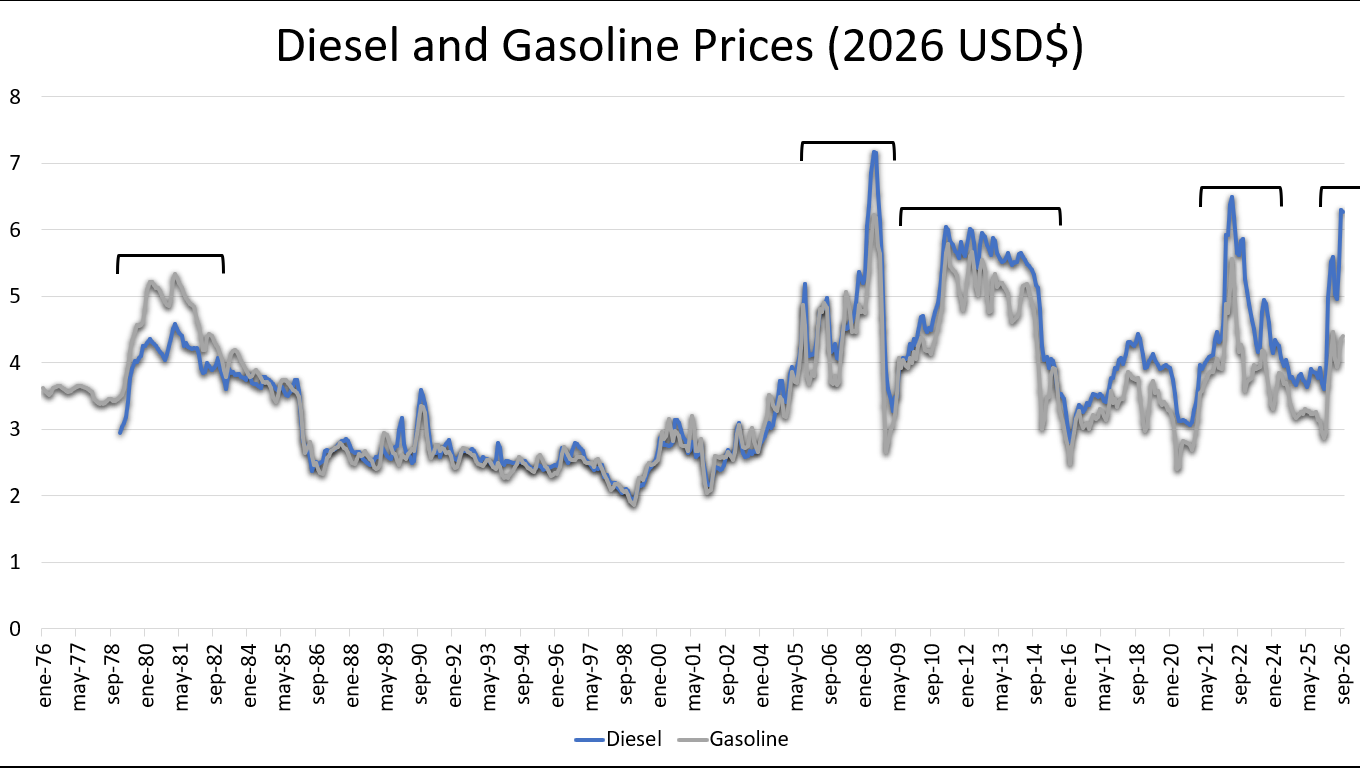
As we can see in the graph, there are 4 such periods in the past, plus the one we’re living today.
- Late 1979 to late 1983. In this period, the US entered a recession and global consumption fell from 64mbd to 58.8mbd, an 8.8% decline. This is the only period in our timeline in which high oil prices have cratered consumption but, remember, this happened in a time when the economy was much more dependent on oil, and it happened because high oil prices triggered a recession.
- Mid 2005 to late 2008. In this period oil consumption rose from 83.3mbd to 86.8mbd, a 4.3% increase. Oil consumption did fell after the 2008 recession, with consumption in 2009 falling to 84.3mbd: this is a 3,1% decline compared to 2008, but since demand was still up from 2005, it’s fair to claim that this decline was due solely to the recession and not to high fuel prices.
- Late 2009 to late 2014. In this period, global oil consumption grew from 84.3mbd to 92mbd, a 9.1% increase.
- Late 2021 to late 2023. Oil consumption went from 97mbd to 102.1mbd, a 5.2% increase.
- March 2026 to the present. And in these few months, oil consumption has fallen by nearly 2.5 million barrels compared to last year (-2.4%).
From these numbers, we can easily conclude that in recent times, high oil prices (in this case defined by fuel being over $4 per gallon, adjusted for inflation) have not triggered reductions in oil demand. This is why many people (myself included) thought that prices would need to go much higher than $4-5 dollars a gallon to trigger demand destruction to the tune of ~2.5mbd we’re seeing today.
(And yes, I know that oil demand has gone down because of physical limitations in the market, but again, the point here is that we thought prices would need to go much higher to cause the demand destruction needed to stabilize the market given that physical limitation).
The conclusion, then, is that the same price that saw year after year growth in the oil market in 2005, 2020 and even 2021, is enough to cause demand to crater in 2026. The only explanation, at least the only one I find, is that in 2026 oil demand is much more susceptible to be influenced by prices.
Final thoughts
I started saying that this crisis either caused or displayed the new reality of oil markets. By this, I meant that it’s possible and even likely that this has been the reality of oil markets for a while, but since we hadn’t had a protracted period of high oil (and fuel) prices, we could not really put the hypothesis to the test.
Regardless, this tracks something that I said in my article Echoes of the Past back when this war started: the last time we saw two oil crises as large and complex as the ones in the 2020’s, the oil market changed forever: oil consumption per-capita, which had grown for decades prior, stabilized; and the oil intensity of the economy started a trend downwards that became a permanent feature of the economy.
This time, I argued, we may see new changes, with oil demand per-capita falling, and the oil intensity of the economy trending towards zero, to the point where overall oil demand could start falling soon if prices remained up. What I didn’t think seven months ago was that this reduction in oil demand could happen with prices barely above what we saw in 2022 or in 2012.
It’s regularly quoted that OPEC’s “ideal” oil price is somewhere in the 90’s or 100’s, as once we get to $120 per barrel we start to see demand destruction. If my analysis is correct, this number is moving downwards, and soon we will start to see demand destruction as soon as oil reaches $90, then $80, then $70, etc.
And in this context, it would be good for the Oil Barons to remember that the man that through sheer arrogance, stupidity, cruelty and lack of foresight has greatly accelerated the transition towards a post-oil World is the same they paid millions to get elected in the presidency of the United States. Because we would not be seeing any of this without the one and only Donald J. Trump, and his cruel and inhuman war on Iran.




Comments
No approved comments yet. Be the first to comment.
Leave A Reply