Trump Backs New TOYO Solar Factory in Texas, Signaling Shift in Solar Stance

Summary
President Trump endorsed a newly completed TOYO solar module factory in Humble, Texas, sending a Commerce Department official to the ribbon-cutting ceremony. The facility has created about 100 jobs, with plans to add a solar cell operation and up to 750 total positions as the 2026 election cycle approaches.
US President Donald Trump stamped his seal of approval on a new solar factory in Texas this week, having dispatched an official from his administration to represent himself on a celebratory tour of the newly completed facility. That doesn’t necessarily mean the war on solar power is over, but it is yet another sign that new manufacturing jobs trump partisan politics, particularly with the 2026 election cycle heating up to the boiling point.
More Solar Manufacturing Jobs For Texas
The solar factory in question comes under the umbrella of the Japan-based startup TOYO. The solar manufacturer has been very busy since its launch in 2022. In November of 2024, TOYO leapfrogged over the competition for a foothold in the US market by absorbing the Houston, Texas firm Solar Plus Technology Texas, which already had the wheels in motion for Phase I construction of a solar module factory in the nearby city of Humble.
“This acquisition marks a significant step in TOYO’s strategy to establish a manufacturing footprint in the U.S., complementing our current manufacturing presence in Vietnam and Ethiopia,” explained TOYO Chairmand and CEO Junsei Ryu in a press statement marking the transaction.
“We are committed to building a robust global solar supply chain structure that efficiently and competitively serves the U.S. market and other regions, adapting to a dynamic policy environment,” Ryu emphasized.
All went according to plan. On October 6, TOYO held a ribbon-cutting ceremony at the Humble facility attended by high level officials including Jeffrey I. Kessler, Under Secretary for Industry and Security at the US Department of Commerce.
And, why should the Trump administration not celebrate? The solar module operation created about 100 new factory floor jobs in Texas, and that’s just for starters. TOYO has already announced plans to co-locate a new solar cell operation at the facility, putting another 400 people to work in the factory. According to the Houston Business Journal, the numbers could ultimately add up to about 750 jobs.
Everybody Loves Solar Power
With hundreds of jobs to celebrate and Election Day 2026 approaching, it sure looks like Trump finally gave up his war on solar power. After all, what good is a new solar module factory when the federal government is actively working to repress growth opportunities for solar power? That just doesn’t make sense!
“Toyo’s announcement is the direct result of the Trump Administration’s bold policies to bring manufacturing and jobs back to America,” enthused Kessler in an official press statement celebrating the new factory.
“By investing hundreds of millions of dollars to expand its Texas factory, onshoring overseas production, and committing to use exclusively US polysilicon, Toyo is making an important contribution to America’s manufacturing renaissance,” Kessler added for good measure.
The US Solar Revolution Has Just Begun
The TOYO facility is just one example of the coming wave of solar manufacturing activity — and a rising tide of solar jobs — in Texas and elsewhere around the US.
If you caught that thing about “US polysilicon,” that’s part of the plan. It’s also another sign of Trump’s waning interest in waging his war against solar power.
Polysilicon is the foundational ingredient for silicon solar cells. Some solar stakeholders have been working to manufacture polysilicon in the US, but the global supply chain is still dominated by China and related allies.
On August 6, Trump did domestic polysilicon manufacturers in the US a solid by issuing an order under Section 232 of the Trade Expansion Act of 1962. The new order set a price floor on imported polysilicon, under the assumption that US manufacturers will pick up the slack.
The Section 232 order was met with mixed feelings by the solar industry. Some domestic manufacturers cheered the news, while others warned of a spike in the price of finished solar modules. However, the order did include a plan to incentivize polysilicon manufacturing in the US, potentially offsetting any price increases.
That may or may not materialize. On its part, the trade organization Solar Energy Industries Association took a cautious approach, noting the risk of rising prices while acknowledging the incentive plan.
“America has made terrific progress rebuilding its solar manufacturing base, but imposing tariffs and prices floors on solar materials will create new challenges for American manufacturers and raise energy costs for families and businesses,” said the organization’s CEO, Tim Pawlenty in a press statement on August 7.
“We appreciate the domestic manufacturing incentives being included in the Proclamation and hope they’ll help offset these challenges,” Pawlenty added.
More Solar Power For The USA, Less Coal Power
When Trump sailed back into office last year, he implemented a topsy-turvey energy policy that downplays the two most abundant and accessible energy resources in the US, namely, wind and solar power, while fawning over coal among other fossil energy resources.
Much good that has done. In its regular summary of US EIA (Energy Information Administration) data, the Sun Day Campaign highlighted this item:
“Electrical generation by utility-scale solar in 2025 increased by 33.79% over that produced in 2024. It is forecast to increase by another 21.16% in 2026 and then increase in 2027 by 18.31% over this year’s output.”
In contrast, coal is dying on the vine. “[M]ilder expected weather this winter, upcoming planned coal plant retirements, and low natural gas prices should keep coal generation this winter lower than last winter,” EIA reported on October 6.
“Coal’s share of utility-scale electrical generation dropped from 28.40% in 2018 to 17.15% in 2025. It will decrease further to 15.73% in 2026 and fall again in 2027 to 14.95% – i.e., roughly half of the level it was at a decade ago,” EIA added.
Ouch!
All else being equal, it’s tough to campaign on job creation when the jobs are mainly limited to a handful of states, and the number of jobs is shrinking steadily, as is the case with the US coal industry. The coal mining workforce was a formidable presence in the US generations ago, when much of the work was done by hand-held equipment. Those jobs have largely vanished under the march of mountaintop removal and other modern coal mining technologies, while the rising risk of black lung disease is further eating away at the workforce.
Additionally, in the early 2000’s a new torrent of low cost natural gas began shutting coal out of the power generation market. Now wind and solar power are finishing the work gas started.
Keep an eye on those new solar jobs as the 2026 election cycle heats up. After all, solar factories are more expansively distributed around the US than coal mines, and so are the solar jobs.
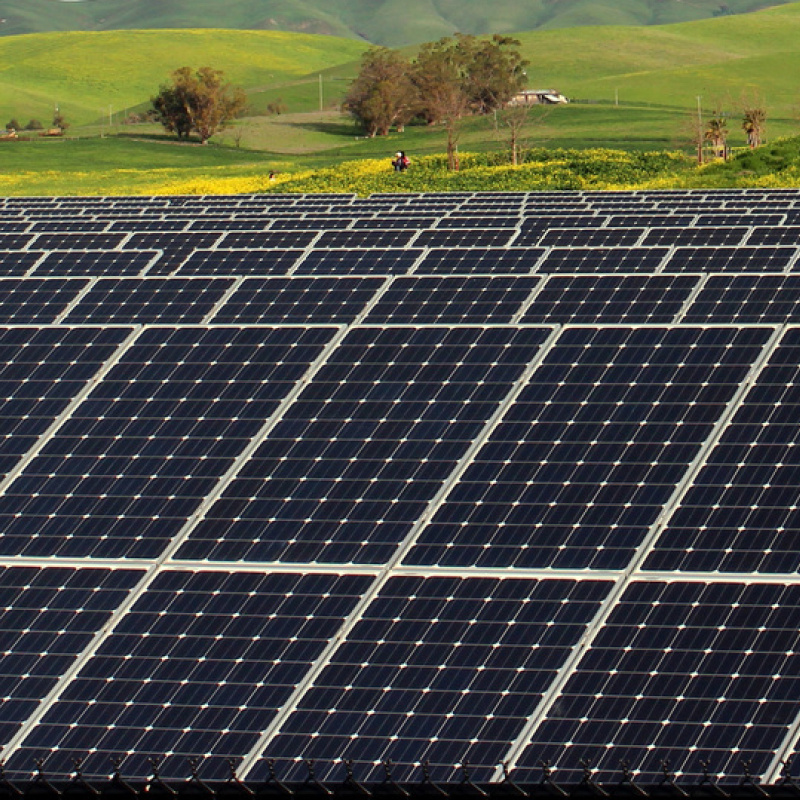
Photo: Despite the last year’s sharp U-turn in federal energy policy, solar power plants continue to add more electricity to the nation’s grid (cropped, courtesy of US Department of Energy),




Comments
No approved comments yet. Be the first to comment.
Leave A Reply