COP31's '35 by 35' Electrification Goal Requires Rapid Shift to Zero-Emission Vehicles
Summary
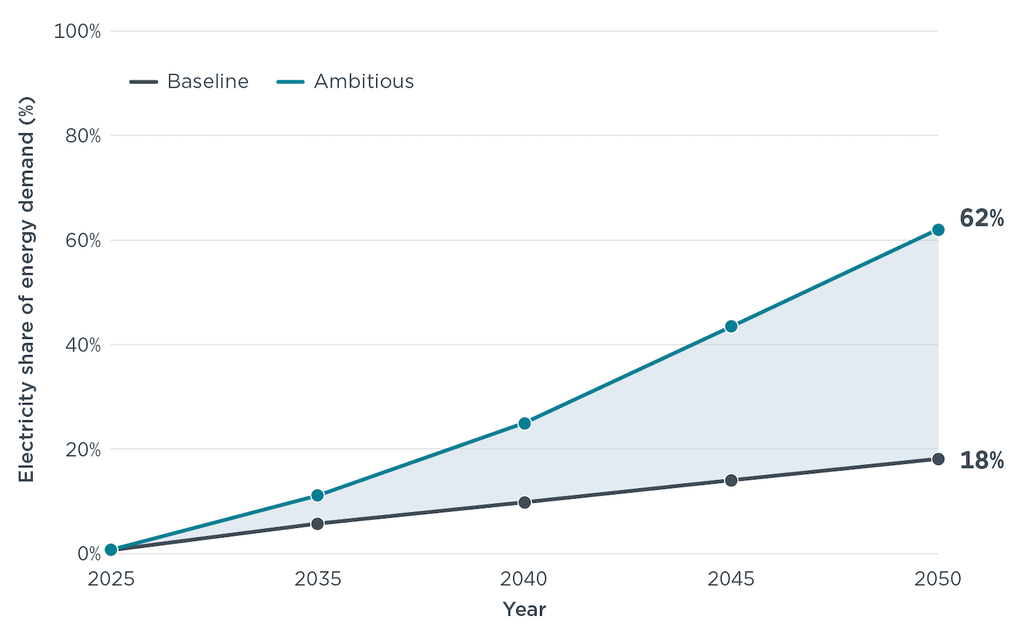
Türkiye and Australia's flagship '35 by 35' initiative aims to double electricity's share of global final energy use to 35% by 2035, which will demand an immediate, rapid transition to zero-emission vehicles. Modeling shows current policies fall far short, with road transport electricity reaching just 6% by 2035 under baseline projections versus 11% in an ambitious ZEV scenario.
Through the COP31 Presidency Action Agenda, Türkiye and Australia have spearheaded the flagship “35 by 35” initiative to raise the share of electricity in global final energy consumption from roughly 20% today to 35% by 2035.
By moving end-use sectors away from direct fossil fuel combustion, this goal is designed to slash global emissions, insulate economies from volatile oil and gas markets, and cut hazardous air pollutants.
As electricity currently accounts for less than 1% of energy consumption in the road transport sector, closing the gap to the 35% target will require an immediate and rapid transition to zero-emission vehicles (ZEVs).
Where current policy stalls
While buildings and heavy industry dominate current electricity use, transport is the fastest-growing frontier for new demand. We modeled two distinct paths for the energy consumption of road transport to evaluate the feasibility of the “35 by 35” ambition.
The Baseline scenario captures the long-term impact of currently adopted policies and anticipated market developments in vehicle sales and fleet turnover across global markets through 2050.
The Ambitious scenario considers full implementation of the ZEV Declaration, which calls for the electrification of light-duty vehicles, and the Global Memorandum of Understanding (MOU) on Zero-emission Medium- and Heavy-Duty Vehicles, which commits signatories to adopt zero-emission trucks and buses.
These two pathways have similar beginnings but diverge sharply toward 2050.
Under the Baseline scenario, electricity reaches just 6% of road-transport energy consumption by 2035 and stalls at 18% by 2050, trailing the benchmark required to support the COP31 Presidency’s milestone. Under the Ambitious scenario, electricity reaches 11% by 2035 and 62% by 2050, more than three times higher than the Baseline projection.
Road vehicles typically remain in service for 15 to 20 years, so even ambitious policies that spur rapid ZEV uptake, such as sales mandates, stringent CO2 and fuel economy standards, and targeted purchase incentives, take time to alter the total operating fleet as older combustion vehicles slowly retire.
Every internal combustion engine vehicle sold today locks in fossil fuel demand well through the 2030s and 2040s, meaning any delay in adopting and strengthening these regulatory frameworks pushes the eventual crossover further out.
What the Ambitious pathway is worth
Accelerating ZEV uptake from the trajectory in the Baseline scenario to that of the Ambitious pathway would avoid an estimated 601 exajoules of cumulative liquid fossil fuel consumption in road transport through 2050. This represents roughly 70% of the total energy savings under the Ambitious scenario and is equivalent to the lifetime fuel consumption of 863 million gasoline-powered passenger cars.
Oil price swings in 2026, driven by OPEC+ supply adjustments and disruptions along critical transit corridors, have reaffirmed the severe macroeconomic exposure faced by countries that depend on oil imports. Replacing this demand through ambitious ZEV adoption in alignment with the “35 by 35” target can help substitute volatile imported oil with electricity, providing a durable hedge against future fuel price shocks.
Our analysis shows that electric vehicle (EV) adoption is already delivering fiscal benefits. In Indonesia, where government fuel subsidies have drained public coffers, electric cars saved the government an estimated $5.8 billion in disbursements in 2025 alone compared to what would have been provided for an equivalent internal combustion fleet.
Over the long term, fully transitioning to electric cars is projected to save the country between $255 and $321 billion in cumulative energy costs through 2060. Globally, the International Energy Agency finds that EVs displaced approximately 1.7 million barrels of oil per day in 2025, a figure on track to triple by 2030 as more emerging markets like India increasingly treat electrification as an energy security imperative rather than solely a climate mandate.
Meeting this scale of fossil fuel displacement will channel a growing share of power needs into road transport. ICCT modeling shows that global electricity demand from road transport is set to rise from roughly 190 terawatt-hours (TWh) in 2025 to over 1,500 TWh by 2035 under the Baseline scenario, roughly equivalent to India’s total electricity consumption today.
Under the Ambitious scenario, demand is projected to rise to 2,600 TWh by 2035 before scaling to 9,000 TWh by 2050, equivalent to China’s total electricity consumption today. Because electric drivetrains are three to four times more energy-efficient than internal combustion engines, this shift will reduce overall energy consumption across the mobility sector, even as transport becomes a prominent source of power demand.
ZEVs strengthen the grid
While electrifying road transport will add new electricity demand, if structured properly, it can also strengthen grids by providing the flexibility needed to absorb more wind and solar power. With smart charging, vehicles draw energy from the grid when renewable power is cheapest.
Meanwhile, bidirectional vehicle-to-grid (V2G) technology lets batteries discharge energy back to the grid when demand peaks. This flexibility smooths out grid stress and lower system costs, helping to ensure that power networks can absorb the expansion of solar and wind capacity required to deliver a 35% electrified global economy.
Recent ICCT grid modeling has demonstrated that managed EV charging directly mitigates infrastructure bottlenecks while lowering systemic costs. In France, smart charging is projected to cut the peak system load in 2040 by 6%, expanding to 9% with bidirectional V2G integration. This managed approach would reduce the need for power line and transformer reinforcements by an estimated 23% and 37%, respectively, ultimately avoiding nearly a quarter of annual network expansion costs as fleet charging surges.
In California, managed charging and off-peak rates could slash projected distribution grid upgrade costs through 2035 from $50 billion to $15 billion. Pairing this with V2G capability would allow ZEVs to return stored renewable electricity back into the system during critical peak load hours, helping avert outages and costly infrastructure builds.
The ZEV Declaration and Global MOU as delivery mechanisms
A global benchmark only moves markets when translated into enforceable rules. The ZEV Declaration and Global MOU provide the multilateral governance architecture needed to coordinate national targets. By committing signatories to 100% ZEV sales of cars and vans by 2035 in leading markets (and by 2040 globally), and to 100% zero-emission truck and bus sales by 2040, these two frameworks send an unambiguous market signal that can derisk private capital investment across manufacturing, battery supply chains, and charging infrastructure.
Achieving the sectoral trajectory modeled in the ICCT’s Ambitious scenario will demand a comprehensive, multi-tiered policy toolkit that reflects the evolving EV adoption and policy landscape. In mature markets, this means moving beyond temporary consumer purchase subsidies toward statutory ZEV mandates, stringent fleet-wide CO2 standards, and feebate systems grounded in polluter-pays principles. For commercial freight, reaching total cost of ownership parity hinges on establishing dedicated charging corridors and fleet purchase requirements. Meanwhile, emerging economies across Latin America and Southeast Asia are driving adoption through targeted fiscal policies and local manufacturing strategies, prioritizing high-mileage urban fleets and two- and three-wheelers.
From ambition to action
Although zero-emission vehicles already reduce CO2 emissions and displace volatile imported oil under today’s grid mix, decarbonizing the power supply will unlock their full climate potential. Concurrently, smart and bi-directional charging can turn growing vehicle fleets into a flexible grid asset and help power networks absorb more wind and solar.
As governments prepare to convene at COP31 to advance energy and industrial strategies, translating global ZEV commitments into enforceable domestic policies represents the most concrete mechanism to deliver on the “35 by 35” goal.
International Council for Clean Transportation. Reproduced with permission,




Comments
No approved comments yet. Be the first to comment.
Leave A Reply