Europe's €5.70/kg hydrogen price exceeds industrial buyers' ceilings, analysis finds
Summary
A European hydrogen assessment finds modeled on-site production at €5.70/kg, while industrial buyers' competitive price ceilings—such as €2.07/kg for process heat—fall far lower. The mismatch means production-cost targets are meaningless without corresponding market price ceilings, a test investors should apply before financing supply.
Europe’s industrial hydrogen plans have a buyer problem. A factory cannot make its products competitive by paying whatever a new hydrogen plant needs to recover its investment. Its maximum hydrogen price is set by the cost of making the same product, or delivering the same useful heat, another way.
The central 2050 scenario in my European hydrogen assessment puts on-site production at €5.70/kg. That starts with electricity at €60/MWh and 53 kWh of electricity per kilogram of hydrogen, so the electricity alone costs €3.18/kg. Electrolysers, capital recovery, maintenance, stack replacements, water and other plant costs bring the total to €5.70. Getting hydrogen to a customer can cost more.
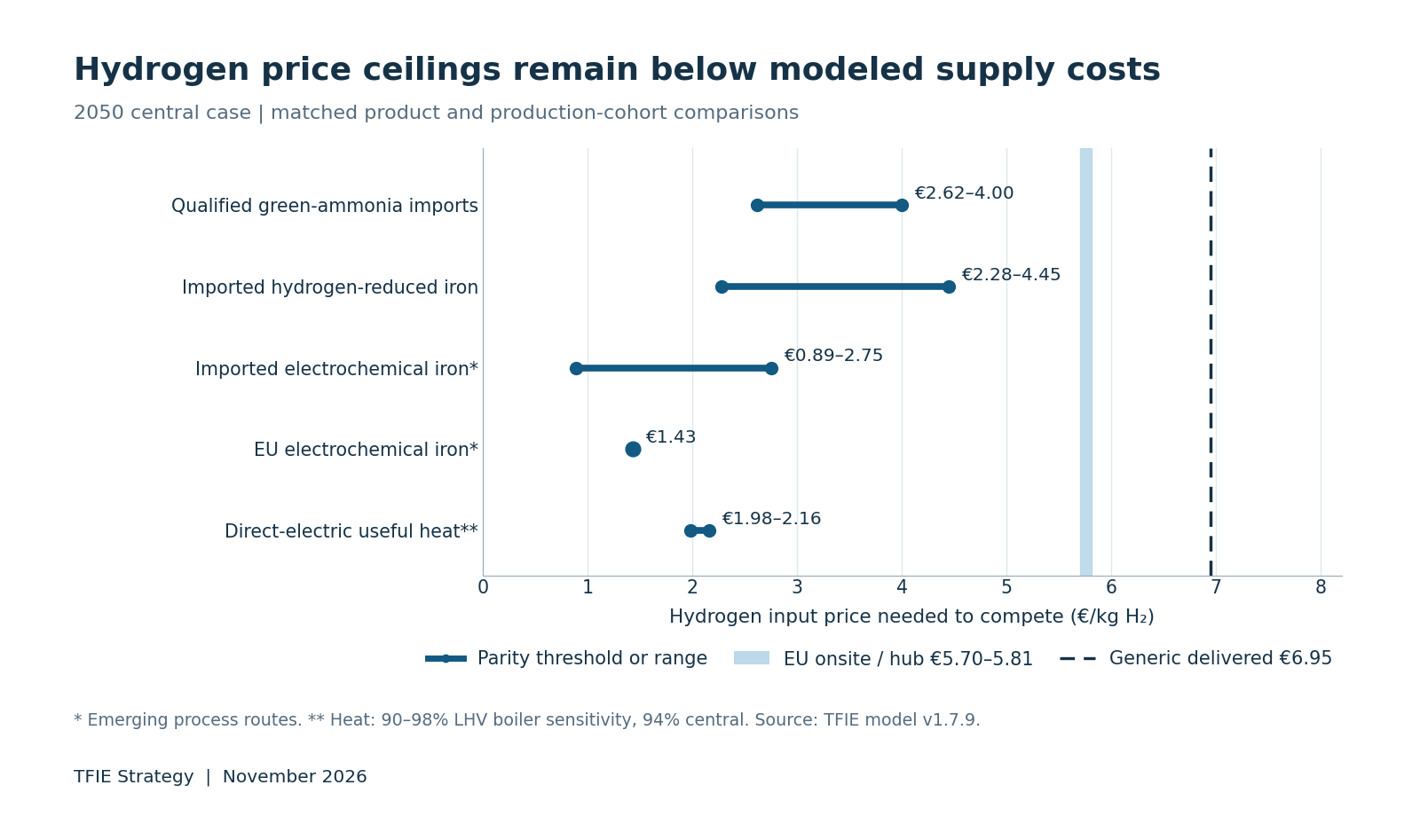
At a factory using hydrogen for process heat, €5.70/kg is an expensive fuel. With 94% heating efficiency, delivering one MWh of useful heat requires roughly 31.9 kg of hydrogen. The fuel bill reaches €182/MWh before the burner, maintenance and other equipment costs. In the model’s central 2050 comparison, suitable direct-electric heating sets a hydrogen price ceiling of €2.07/kg. At that ceiling the same hydrogen heat costs about €66/MWh. The hydrogen production case overshoots the customer’s competitive input price by €3.63/kg.
The mismatch is not a prediction that hydrogen makers will never lower costs. It is the actual commercial test investors should apply before financing supply. Reducing the cost of production from €7 to €5 a kilogram achieves little if the relevant industrial customer can pay €2. Production-cost targets are meaningless without a corresponding market price ceiling.
The International Energy Agency’s Global Hydrogen Review 2026 has made customer cost acceptability part of its assessment. Across most sector and region comparisons, the IEA finds maximum acceptable hydrogen prices below US$2/kg without policy support. Some incumbent-steel comparisons yield negative acceptable prices. The IEA examines a 2035 horizon and a different set of competitors; the same buyer-side arithmetic exposes the problem.
My TFIE Strategy Briefing assessment calculates the maximum hydrogen input price for industrial heat, ammonia and ironmaking and compares it with distinct European supply cases. It also links to the underlying European hydrogen research and interactive model.
European ammonia illustrates how demand for a product differs from demand for European-made hydrogen. Ammonia remains necessary for fertilisers and industrial chemicals. The buyer’s real choice is where to produce it. In the central 2050 TFIE model, making qualifying green ammonia inside Europe can compete with imported green ammonia only when its hydrogen input costs roughly €2.62–€4.00/kg, depending on the origin and production route. The €5.70/kg onsite supply case misses those thresholds. Europe can keep consuming ammonia without building every electrolyser locally.
Ironmaking has a similar sourcing decision. The model’s hydrogen input-price ceiling versus qualifying imported hydrogen-reduced or hot-briquetted iron ranges from €2.28 to €4.45/kg. Against a European electrochemical iron process, the central ceiling is approximately €1.43/kg. Where enough suitable scrap can deliver the required steel grade, the hydrogen-based route can lose even at a zero price for hydrogen. Steel quality, industrial integration and the commercial maturity of electrochemical iron matter to those comparisons. They do not entitle a hydrogen supplier to ignore the alternatives.
Hydrogen used as a chemical reagent deserves a different assessment from hydrogen burned for heat. Chemical production may need the molecule. Industrial heating needs temperature, pressure, reliability and useful energy, all of which can be delivered directly from electricity for many applications. Manufacturing hydrogen from electricity and then burning it adds conversion losses and fuel-system costs before the plant receives the heat it needs.
The supply cases have defined boundaries. The central onsite cost is €5.70/kg. A generic delivery allowance takes that case to €6.95/kg. The model’s separately configured hub-and-pipeline case is €5.81/kg. Those are different cost structures, not interchangeable price quotes for the same customer. Even the favourable 2050 case, at €3.46/kg with its specified delivery allowance and €28/MWh electricity, clears some industrial thresholds but still misses others.
Policy can create demand that market prices do not support. Carbon pricing, procurement mandates, subsidies and carbon contracts for difference can raise willingness or obligation to pay. That may be a deliberate industrial or climate choice, but governments should disclose the premium, who will finance it and the contract duration. Describing a regulated purchase as competitive demand hides the cost rather than eliminating it.
The EU energy regulators’ market monitoring points in the same direction. ACER reported 4.2 GW of committed electrolyser capacity in November 2026, including operating plants, projects under construction and those with final investment decisions. Roughly 49% was associated with refining, where renewable-fuel mandates provide a strong demand signal. The remaining industrial sectors face a harder test when policy does not compel the same purchases.
For lenders, the consequence is immediate. A proposed hydrogen plant costing €5/kg has no viable commercial case when its intended industrial buyer can afford €3/kg. A memorandum of understanding cannot close that €2/kg gap. Developers need buyers with enforceable contracts at prices that cover supply costs, lower production costs, or identified support durable enough to finance the difference.
Industrial and public procurement should start with the product the customer must deliver, calculate the best eligible competing route, and determine the maximum hydrogen price that route permits. Only then should investors consider electrolysers, pipelines and capacity targets. Suppliers do not set the market by drawing cheaper future cost curves. Industrial customers set the ceiling.
The full TFIE Briefing and open European hydrogen assessment contain the industrial route comparisons, scenario assumptions and research submitted to the European Commission. The next Briefing examines the competing routes for sourcing green ammonia and iron.


Comments
No approved comments yet. Be the first to comment.
Leave A Reply