Avery Dennison and Argent Test PSA Tape Aging for 30-Year Battery Storage Lifetimes
Summary
Pressure-sensitive adhesive tape suppliers are testing dielectric materials for battery energy storage system (BESS) lifetimes of 30 years or more as rising pack voltages raise tracking performance requirements. Avery Dennison and Argent detailed accelerated aging protocols, including 3,000-hour tests at 85°C and 85% relative humidity, during an Energy-Storage.news webinar.
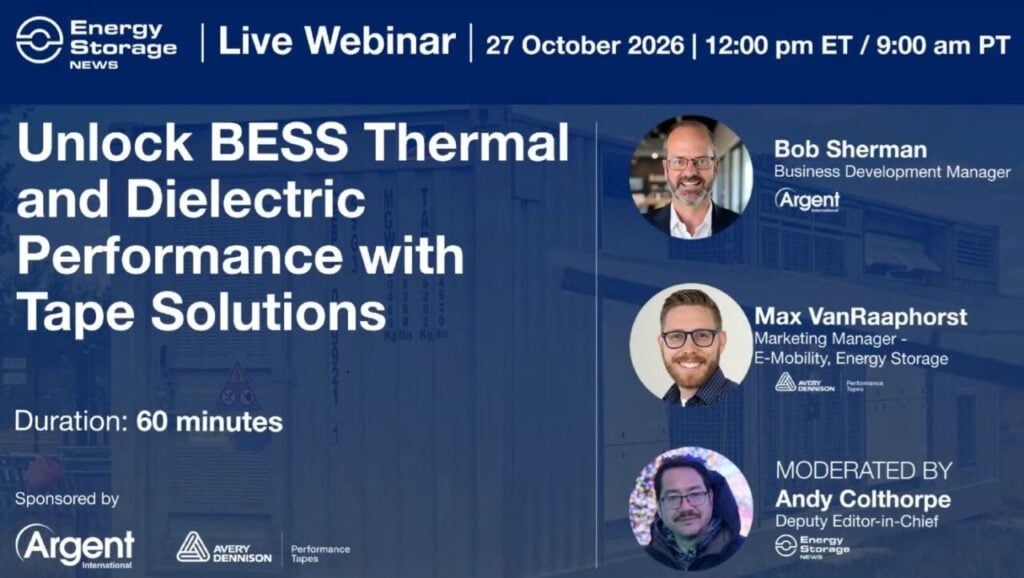
Pressure-sensitive adhesive (PSA) tape suppliers are testing dielectric materials for battery energy storage system (BESS) lifetimes of 30 years or more, as rising pack voltages push tracking performance requirements higher, an Energy-Storage.news webinar heard.
Max Van Raaphorst, market manager for e-mobility and energy storage at Avery Dennison Performance Tapes, said: “We know that your structures are going to have to last and are expected to last a lot longer than like an e-mobility type application.”
Speaking on the webinar Improving BESS thermal and dielectric performance with PSA tape, sponsored by Argent International, Van Raaphorst said accelerated ageing at 85°C and 85% relative humidity was a common baseline for BESS customers.
The company was “extending that out to 3,000 hours, whereas in automotive it might be shorter, around 500 or so, give or take by OEM,” he said.
Argent, a custom die cutter based in Plymouth, Michigan, laminates Avery Dennison’s adhesives to film, foam or fabric and die cuts the finished parts. Avery Dennison, which manufactures the tapes, joined as a guest speaker.
Van Raaphorst said BESS customers were using LFP enhanced for high duty cycles, and are increasingly considering sodium-ion (Na-ion) solutions, but that “the common feature is they want to reduce total cost of ownership for the lifetime of that container, and the longer it lasts, and the more cycles it can perform, the better.”
He said environmental cycling tests ran over months but needed to “accelerate and represent years”, and that the company would often test to the harshest customer requirement it found, “and maybe even a little bit past it”.
Van Raaphorst said he did not want a call 29 years after making a recommendation because a product expected to last 30 years had failed. “So, we want to make sure it’s good well past 30, and doesn’t just squeak on through,” he said.
Andy Colthorpe, editor of Energy-Storage.news, who moderated the session, framed the question around an industry shift towards treating storage assets as “less of a short-term merchant play and more of a long-term kind of infrastructure play”.
Longer guarantees have started to appear at system level, with Hydro-Quebec subsidiary EVLO offering 25-year warranty and performance guarantee packages on a 5MWh BESS using Hithium DC blocks in October 2024.
Asked about engineers more familiar with tape as a temporary fix, Van Raaphorst said everyday consumer tapes “are designed consumer-grade materials and designed to be relatively easy to take off,” whereas some industrial PSAs had been in continuous field use for 30 to 40 years.
Tape versus coatings for dielectric protection
On dielectric protection, Van Raaphorst said some of Avery Dennison’s latest tapes had passed 1,000V comparative tracking index (CTI) testing as pack voltages increased.
That “allows for a lot tighter of packaging for your creepage clearance, and therefore improves your energy density per container by switching to that solution,” he said.
Container energy density has risen quickly. For example, Chinese manufacturer Gotion launched a 7MWh 20-foot DC block built on its 650Ah cell in March 2025, against the 5MWh that had become the baseline for 20-foot containers.
Van Raaphorst said the company’s top-coating capabilities could lift a PET film’s CTI from around 400V to 600V or 800V or higher, and that modified PET allowed thermal interface materials to adhere without plasma pre-treatment.
He set out where tape could have an advantage over dielectric coatings. Coatings tended to thin around corners, which “can be an area of weakness that might cause rework after high pot as well as with pinholes,” he said.
On flat surfaces, Avery Dennison targets “a plus or minus 5 micron thickness variation, which is an order of magnitude better than majority of the coatings that we see in the market,” Van Raaphorst said.
Coating lines also needed wash stations, drying ovens, curing and cool-down areas, he said. Bob Sherman, business development manager at Argent International, made the same point about PSA application: “There’s no curing time. There’s no oven. There’s no UV lights.”
Van Raaphorst said some engineers asked for masking tape so they could apply coatings only where needed. “Instead of applying tape where you want no dielectric protection, think about applying tape to where you need it, and that saves a significant amount of steps,” he said.
Common uses included prismatic cell cans, cell connection systems, and cooling plates and ribbons, where a thinner layer improved heat flow. He was clear that tape would not suit every application, however.
“There are instances absolutely where you should use a coating. If you come to me and it’s a coating application, I’m going to tell you,” Van Raaphorst said.
On thermal runaway, he described a venting tape with what he called an “anisotropic-like” response to flame. One continuous length could seal multiple vent holes in a venting channel, letting an individual cell in thermal runaway vent through it.
When in contact with flame, “it bursts through nearly instantly, and yet it’s designed so that on the other side, it can resist burning through for a set period of time,” Van Raaphorst said. This prevented a pack and container “from turning into a large convection oven”, he added.
Venting has also been a focus of container-level fire testing. Sungrow burned four 2.752MWh PowerTitan units in a live-streamed test to show fire did not spread to neighbouring containers, with roof deflagration panels venting flames upward.
Van Raaphorst said there was still no single thermal runaway barrier material “that is just absolutely perfect for every application”, which was why the companies laminated several materials into composites.
“The whole thermal runaway mitigation is a holistic systems level approach, right? So, no one material is doing all of the work by any means,” he said.
Sherman said Argent drew on its automotive EV work but acknowledged the limits of that experience. “I understand that a car is different than a BESS, right? So I’m not saying that we know everything on that regard,” he said.
He said engineers should engage tape suppliers as early as possible, and that it was “kind of never too late,” although “once the design gets kind of finalised and you’ve got all your drawings set, it becomes just more challenging”.
To build confidence with OEMs, Van Raaphorst said the companies tested at coupon level and then worked with tier ones or OEMs “to do larger module level and build up the robustness of data”, including simulation work using virtual twins.
Looking ahead, he said automation and robotic assembly would continue to shape tape design. “That’s going to help drive down costs. That’s going to improve quality, and that’s going to help with scale,” Van Raaphorst said.
He expected more functions to be combined into single parts, so that manufacturers could use “one part that does three things instead of three parts that all do one thing”.
Cutting part count has also been a theme at cell level, with CATL saying at SNEC 2025 that its 587Ah cell reduced system components from 30,000 to 18,000 as Chinese manufacturers moved to cells of 500Ah and above.
See the webinar on YouTube above. You can also register to watch the webinar and get access to presentation slides from the on-demand section of our website, where you can also find all our other great Energy-Storage.news webinars.


Comments
No approved comments yet. Be the first to comment.
Leave A Reply