Spain's battery storage revenues shift from grid balancing to arbitrage and capacity contracts
Summary
Spain's first battery fleet, roughly 250-320MW and mostly paired with solar, currently earns most of its revenue from balancing services such as aFRR. As storage capacity triples and more projects come online, value is broadening into arbitrage, capacity contracts and new demand, rewarding projects structured for that mix.
Spain’s first batteries earn mostly from balancing services. As the fleet grows, value is broadening into arbitrage, capacity contracts and new demand, and the projects that capture it will be the ones structured for that mix, writes Roy Franco of renewables investor Energile.
Start with what is actually running
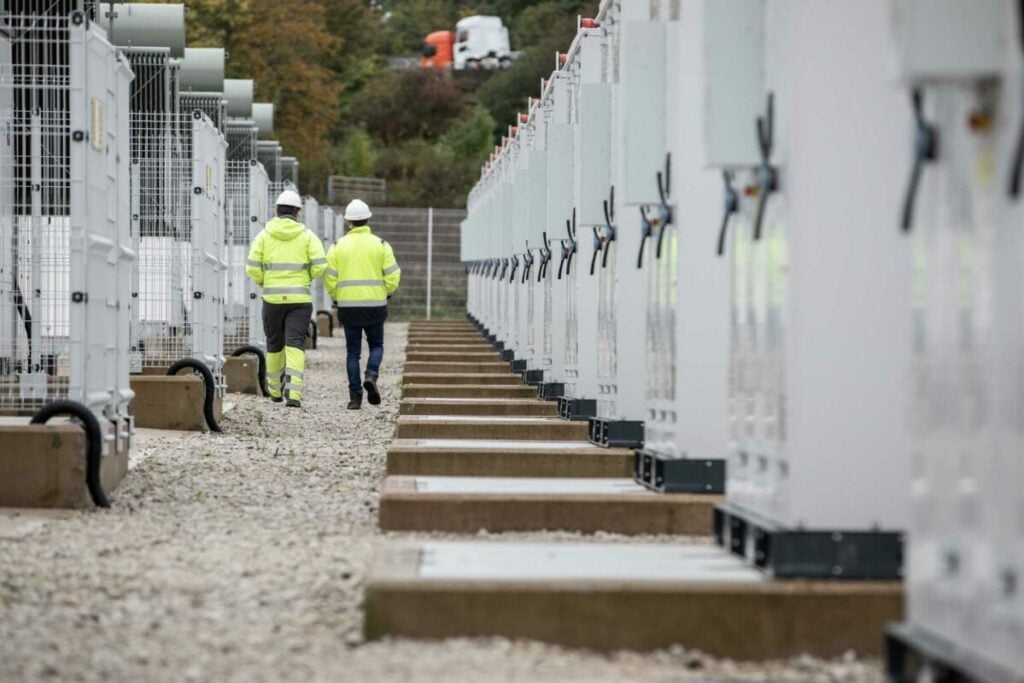
How much battery capacity is operating in Spain depends on who is counting. TSO Red Eléctrica’s monthly figures put installed batteries at 260.8MW in August 2026, up from 96MW at the end of 2025. Its grid-access data shows 321MW of storage in service at September 30, of which 16MW is standalone. Aurora Energy Research counted 256MW operating in early September, 12MW of it standalone. Orka Energía, which only counts plants with a final operating authorisation, put the figure nearer 150MW in August.
So the honest answer is roughly 250 to 320MW connected, almost all of it paired with solar, with somewhat less trading every day. That fleet has roughly tripled since the end of 2025, and Red Eléctrica records 34.2GW of storage with grid-access permits behind it. Spain’s storage market is moving fast.
Where the money comes from today
Aurora estimates that a two-hour battery trading in the wholesale market and in secondary and tertiary reserve would have earned about €229,000 (US$252,000) per MW in gross revenue over the 12 months to August 2026. A four-hour battery would have earned about €281,000 per MW. Day-ahead and intraday trading delivered around 19% of the two-hour battery’s revenue and 37% of the four-hour battery’s. Secondary regulation (aFRR) delivered 80% and 62%.
Arbitrage is real and growing. Spanish solar captured 48% of the average day-ahead price in 2026 through late September, according to UNEF, while evening prices ran at 181% of the average and the market logged 743 negative-price hours. One solar plant with an 11 MWbattery captured 91% of the average price over a 56-day window, against 54% for a similar plant without storage. That gap is the opportunity for every operating solar plant with room to add storage.
Reserve markets are a defined pool. Red Eléctrica reports that secondary reserve cost about €350 million in the first ten months of 2026, out of €4.7 billion in total balancing costs. Batteries can also earn from mFRR energy, traded through the European MARI platform since December 2024, and from constraint management at congested nodes. As the fleet grows, the edge goes to owners who trade across all of these markets.
What changes over the next few years
Reserve prices are normalising. Modo Energy calculates that average upward aFRR capacity prices moved from about €26/MW/h in 2024 to about €13 in 2025 and about €9 in the first half of 2026, mostly because renewable portfolios now bid in solar hours, before batteries arrived in any volume. That shifts value toward arbitrage, capacity contracts and new demand, where batteries have the edge. Aurora expects the wholesale market to become the main revenue source, followed by balancing and capacity payments.
The capacity market is the second change. Order TED/966/2026 entered into force on September 18 after European Commission approval in May, with a budget of up to about €900 million a year through 2036. Auctions are technology-neutral and pay-as-bid, priced in euros per firm MW per year, and new storage can win contracts of up to 15 years. Battery capacity is derated by a firmness coefficient and capped at the grid-access capacity, so a 100MW battery does not sell 100 firm MW. The first auction has not been called yet. The ministry has aimed to define it before the November 29 general election, and once a call is issued, applications run at least a month and close six weeks before the auction. Aurora sees capacity payments as a modest but stable floor that supports financing, since existing gas plants will compete for the same contracts.
The third change is grid investment. The government’s transmission plan to 2030, presented to Congress on November 12 and awaiting final Cabinet approval, commits €17.1 billion, nearly 150% more than the current plan, to serve 47GW of new demand. New lines and substations will open connections and shift where congestion, and the constraint revenue that comes with it, sits. For batteries, location will matter as much as duration.
The fourth, and the most durable, is new demand. The grid plan’s 47GW of new connections includes 14.9GW for industry, 12.4GW for renewable hydrogen and 9.3GW for data centers, and the data center sector puts its own potential demand at about 22GW. Demand on that scale means Spain will need much more generation, much of it solar and wind, and storage to make that output available when customers need it. A draft decree tying data center grid access to hourly renewable matching would make that need explicit. That gives batteries a role that outlasts today’s price signals.
What lenders will finance
Financing well in Spain means building around revenue lenders can see.
First, a capacity contract is the most bankable revenue a Spanish battery can win, because it is long and paid in euros per MW. Debt will be sized on derated firm capacity and the actual clearing price, so modeling both carefully pays off.
Second, merchant revenue finances best with a wrapper. A toll pays a fixed or predictable fee for the battery’s availability, and the counterparty takes the market risk. An optimiser contract with a revenue floor keeps more upside for the owner, with lenders focused on the floor level, its tenor against the loan, and the optimiser’s credit. Availability, degradation, cycle limits and performance guarantees decide what these contracts are worth.
Third, lenders size aFRR income conservatively. Modo expects upward capacity prices to keep easing toward 2030, so projects that treat reserve income as upside rather than base case are the ones that close.
The structure that works is a contracted base, combining a capacity contract with a toll or floor, sized to cover debt service, with merchant trading on top as the equity return. For hybrids, the shared grid connection lowers cost, and reviewing existing solar contracts early keeps the battery free to trade.
Three questions for investors
What share of revenue is contracted, and for how long? Who runs the battery, and how are they paid? And does the case work as reserve prices keep normalising? Spanish batteries earn well today, and the demand behind them keeps growing. Investors who structure for the next revenue mix are the ones who will capture it.
About the author
Roy Franco is the founder and managing partner of Energile, a Madrid-based investor in renewable energy assets in Europe with a focus on Spain. Founded in 2020, Energile acquires ready-to-build and operational assets with a value-add approach, enhancing assets through financing optimisation, technical upgrades, battery integration and active revenue management.


Comments
No approved comments yet. Be the first to comment.
Leave A Reply