Europe's Inland Barges Must Plan Cargo Before Electric Fleet, Study Warns
Summary
Rising coal and oil throughput at Rotterdam masks a long-term shift that will reshape inland waterway freight through 2050, according to a new electrification strategy briefing. It argues vessel owners should model future cargo demand before committing capital to electric engines, batteries or replacement vessels.
Coal throughput at Rotterdam rose 15.3% in the first nine months of 2026. Crude oil and petroleum-product volumes also increased. An inland vessel operator looking only at this year’s cargo market could see decades of work ahead. But an engine, battery conversion or replacement vessel bought now may still be operating in 2050, when the mix of cargo travelling through European ports and rivers will be different.
Rotterdam’s latest throughput release explains the coal rebound through recovering coking-coal movements, expensive natural gas and power-market conditions. Meanwhile, Eurostat reports that EU inland-waterway freight fell 3% in 2025 to 118 billion tonne-kilometres. Coal and crude-petroleum freight rose that year, while agricultural freight contracted. These changes are reshaping the services that ports, vessel owners and customers need to buy.
The Central Commission for the Navigation of the Rhine counted 6,224 dry-cargo vessels in Rhine countries in 2025, down from 6,410 in 2023. Smaller vessels account for much of the decline. Tankers moved the other way, rising from 1,400 in 2022 to 1,477 in 2025. The numbers describe a fleet already adapting to changing cargo and operating economics.
My TFIE Strategy Briefing on the inland barges Europe will need in 2050 uses a cargo-first model to work from the freight task to the future electric fleet. The underlying 98-page Inland Freight Electrification report is available to read.
A vessel owner has two connected capital decisions. The first is whether the freight service will still have customers through the useful life of the asset. The second is which propulsion and charging system can perform that service economically. Starting with equipment and then finding a market for it risks spending scarce investment capital on the wrong vessels.
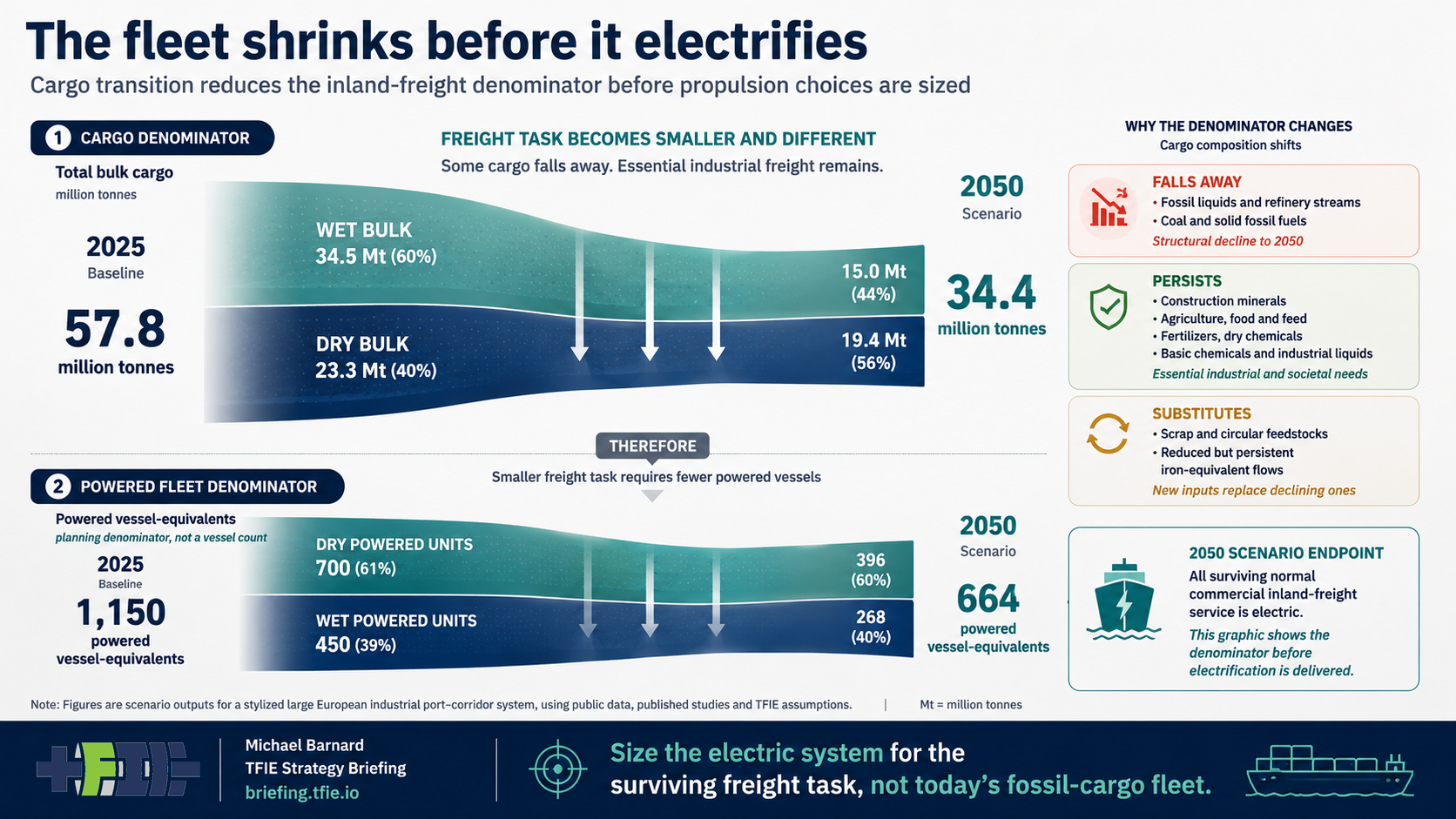
I modelled a large European industrial port corridor from a 2025-style baseline to 2050. The central scenario assumes bulk cargo falls from 57.8 million tonnes to 34.4 million tonnes, a decline of about 40%. Wet bulk accounts for much of the loss, falling from 34.5 million to 15.0 million tonnes. Dry bulk declines from 23.3 million to 19.4 million tonnes. The model is a transparent scenario for investment decisions across this type of corridor, rather than a forecast of Rotterdam’s exact future cargo volumes.
The largest change is fossil-linked cargo. Fossil fuels and refinery streams fall from 19.0 million tonnes to 1.5 million tonnes, while coal and other solid fossil fuels fall from 2.5 million tonnes to zero. Combined, those reductions account for about 20 million tonnes of the scenario’s 23.4-million-tonne net decline. Any operator whose principal customers depend on moving coal or petroleum faces a different replacement decision from one carrying grain, construction minerals, chemicals or scrap.
Steel illustrates what cargo substitution means. The model reduces imported iron ore and other virgin iron units from 4.5 million tonnes to 3.0 million tonnes, while scrap and circular feedstocks rise from 1.8 million to 3.5 million tonnes. The industrial function continues as the materials moving to and from factories change. Existing barges and terminals may find new work, although parcel sizes, loading systems and routes will also change.
Biofuel feedstocks create a second trap. In the central scenario those movements peak near 5 million tonnes in 2030 before falling to 1.5 million tonnes in 2050. A temporary freight boom can support profitable operations without supporting a new vessel or terminal investment with a thirty-year life. The durability of the contract matters as much as the volume carried this year.
Cargo tonnage alone cannot size an electric fleet. The model translates commodities into powered vessel-equivalents using parcel sizes, routes, loaded calls and productivity. It starts with around 1,150 powered vessel-equivalents and ends with 664, a reduction of 42%. Dry cargo falls 17% in tonnes but 43% in powered vessel-equivalents because the modelled freight service changes. The starting 1,150 powered equivalents represent about 1,234 physical hulls after counting unpowered barges moved by pushers. Battery conversion decisions concern powered units; terminal and cargo-handling decisions also concern the additional hulls.
That distinction is particularly important for pushed formations. A pusher provides propulsion for several cargo barges. Converting one powered unit does not necessarily mean replacing every physical hull. Counting all hulls as propulsion conversions would inflate the equipment and financing requirement.
Low Rhine water levels bring a different constraint into the same calculation. A barge can remain on the register yet carry less freight per journey when draught is restricted. Cargo owners may have to buy more voyages, use different hulls or shift some freight to rail and road. Route depth, seasonal load factors and terminal access belong in the service model alongside cargo demand.
Ports should begin with a living cargo and route register showing which freight is declining, which remains, and which changes its material inputs. Vessel owners can connect that register to remaining hull life, annual utilization, cargo contracts and the cost of electric conversion. Utilities and terminal operators can then size grid connections, charging facilities and battery-container pools against vessels that will run on bankable routes. Infrastructure developed around dependable freight customers has a stronger prospect of earning a return.
Europe has good reasons to electrify established, high-utilization inland freight now. Battery-powered vessels are already serving container and bulk routes. The commercial opportunity is to invest in routes with surviving customers and electrify the services they will continue to buy. Expanding an electric fleet before measuring that freight task puts the order of decisions backward.
The complete TFIE Strategy Briefing works through the cargo substitutions, fleet denominator and investment decisions. The open Inland Freight Electrification report includes route-energy modelling, battery-pool sizing, terminal requirements and programme economics. TFIE Strategy also undertakes scoped corridor and fleet assessments for ports, operators and cargo owners.



Comments
No approved comments yet. Be the first to comment.
Leave A Reply