New Zealand regulator corrects start date for 10-band BESS wholesale market offers to March 2028
Summary
New Zealand's Electricity Authority has moved the effective date for allowing battery storage owners to submit up to 10 price bands in wholesale offers from 30 October 2026 to 31 March 2028. The regulator called the fix technical and non-controversial, noting market systems cannot process more than five bands until planned software upgrades are complete.
New Zealand’s Electricity Authority has corrected the date from which battery energy storage system (BESS) owners can submit up to 10 price bands in their wholesale market offers.
The Electricity Authority Te Mana Hiko, the country’s electricity market regulator, said on 17 November that the change to clause 13.12 of the Electricity Industry Participation Code (the Code) now takes effect on 31 March 2028, rather than 30 October 2026.
Clause 13.12 sets how many price bands a generator can use in an offer, with each band pairing a volume of MW with a price. Generators are limited to five bands per trading period, while the amended clause gives BESS owners up to 10.
The change formed part of the Authority’s Code amendment on wholesale market arrangements for BESS, the rules that govern how BESS owners bid, offer and are dispatched in the spot market, published in a decision paper in late September.
According to an addendum to that paper, the 10-band clause was “inadvertently included” in the first phase of the amendment, which took effect on 30 October, rather than the second.
The Clearing Manager and the System Operator, which settle and run the market, cannot process offers with more than five bands until planned system upgrades are complete.
To fix this, the Authority will remove the 10-band option from 18 December 2026, reinstating the clause as it stood before 30 October, and add it back from 31 March 2028.
The Authority described the change as “technical and non-controversial”, meaning it did not require further consultation, and said it would help ensure “BESS owners do not submit offers that cannot be processed in the market.”
Two-phase rollout for a growing fleet
The September decision split the BESS rules into two phases because the software changes take time to deliver.
The first phase requires BESS to be dispatchable during both charging and discharging and allows owners to update trades after gate closure as their expected capability changes.
The final phase, on 31 March 2028, introduces a single bid-and-offer form for each BESS, 10 price bands for bids and offers, and state-of-charge constraints in the dispatch software. The Authority pushed that phase back by three months from its consultation timeline to allow for upgrades to multiple frequency-keeping software systems.
The decision paper lists six utility-scale BESS in New Zealand as commissioned, under construction, or committed, all but one of which are 2-hour systems connected to the transmission grid.
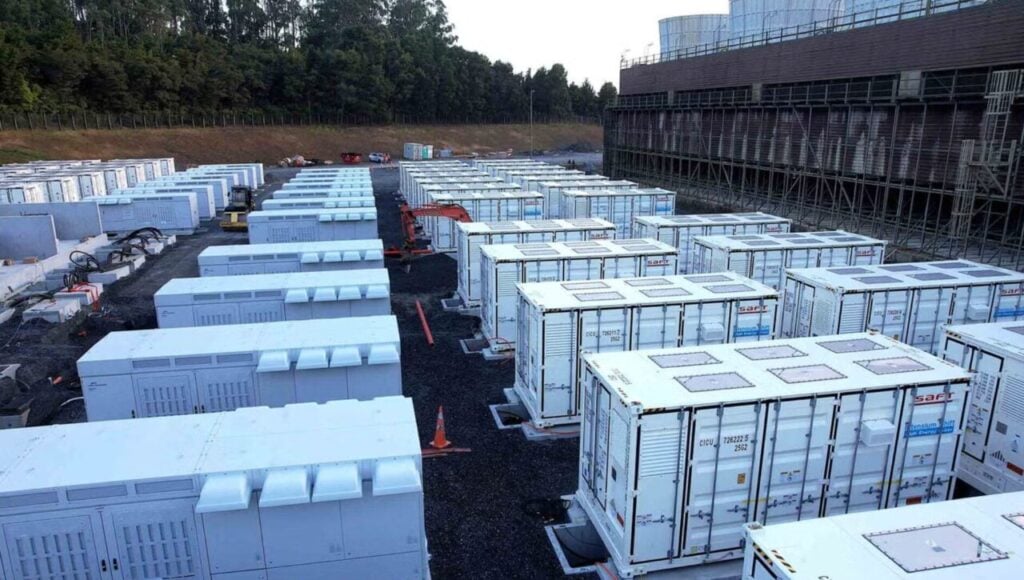
They include Meridian Energy’s 100MW/200MWh Ruakākā BESS, which Meridian committed to in December 2022 with Saft as supplier, and Contact Energy’s 100MW/200MWh Glenbrook Ohurua Battery 1 in South Auckland, built with 56 Tesla Megapack 2XL units. Contact is also building a 200MW/400MWh second BESS at the same site.
Genesis Energy opened its 100MW/200MWh BESS at Huntly Power Station, New Zealand’s largest power station, in October, with a second system of the same size committed for the site.
New entrants are also arriving, with energy storage developer Eku Energy acquiring a utility-scale BESS project in the Waikato region in June, its first in the country.
The rule changes come as Transpower, the state-owned grid owner and system operator, warned in its draft 2026 Security of Supply Assessment that New Zealand faces a 698GWh winter energy shortfall by 2031, even with a record pipeline of new projects.
The Authority also said its next Code amendment consultation, on BESS hybrids, which combine BESS with wind or solar PV generation at a single grid connection point, has moved from late 2026 to early 2027.
It will cover common quality requirements, the technical standards plant must meet to keep the power system stable, and trading arrangements for hybrid stations.
Its issues and options paper on BESS hybrids drew 15 submissions, including from Meridian, Contact, Genesis, Tesla and Transpower, before closing on 30 June. The Authority said it will shortly issue guidance on how prospective hybrid station owners can operate and trade in the meantime.


Comments
No approved comments yet. Be the first to comment.
Leave A Reply