Hyundai Staria Load Electric Review: Strong Efficiency and Comfort, but Is the $71,000 Price Justified?
Summary
Hyundai's Staria Load Electric impresses with efficiency, comfort and practicality, backed by an 84kWh battery, 450km claimed range and 800-volt fast charging. However, its $70,990 starting price is $21,000 above the diesel version, raising questions over value for commercial buyers.
Hyundai’s Staria has always looked a little like something designed to transport astronauts between terminals at a space station. So it seems only appropriate that the Korean carmaker has finally given its futuristic-looking van an electric powertrain.
The new Staria Load Electric joins the diesel and hybrid versions in Hyundai’s commercial vehicle line-up, bringing with it a sizeable battery, impressive charging capabilities and the promise of significantly lower running costs that come with an electric vehicle.
But there’s a catch. Starting at $70,990 before on-road costs, the electric Staria costs $21,000 more than its diesel counterpart and $17,500 more than the standard hybrid.
It’s a significant premium for a vehicle designed primarily to earn its keep, and after spending the best part of a week driving it around Sydney, it’s also one of the biggest questions I came away with.
The Staria Load Electric comes with an 84 kWh battery powering a front-mounted electric motor producing 160 kW and 350 Nm of torque.
Hyundai claims a driving range of up to 450 kilometres on the WLTP cycle, which is pretty respectable for a vehicle measuring more than 5.2 metres long and weighing upwards of 2.2 tonnes.
Of course, load it up with a tonne of equipment and spend the day travelling at motorway speeds, and that figure is likely to fall.
But for urban deliveries, tradespeople and businesses travelling relatively predictable routes, the claimed range should provide plenty of flexibility.
One of the more impressive aspects of the electric Staria is its 800-volt electrical architecture, enabling quick DC charging.
Hyundai claims the battery can be charged from 10 to 80 per cent in just 20 minutes when connected to a suitable 350 kW fast charger, although the actual top DC charging speed is closer to 250 kW. AC charging is supported at up to 10.5 kW.
The 800v architecture could be particularly useful for commercial operators, where time spent charging during working hours can mean lost productivity.
Of course, nobody buys a commercial van because they’re particularly interested in its zero-to-100 km/h acceleration time. They buy one because they need to carry stuff.
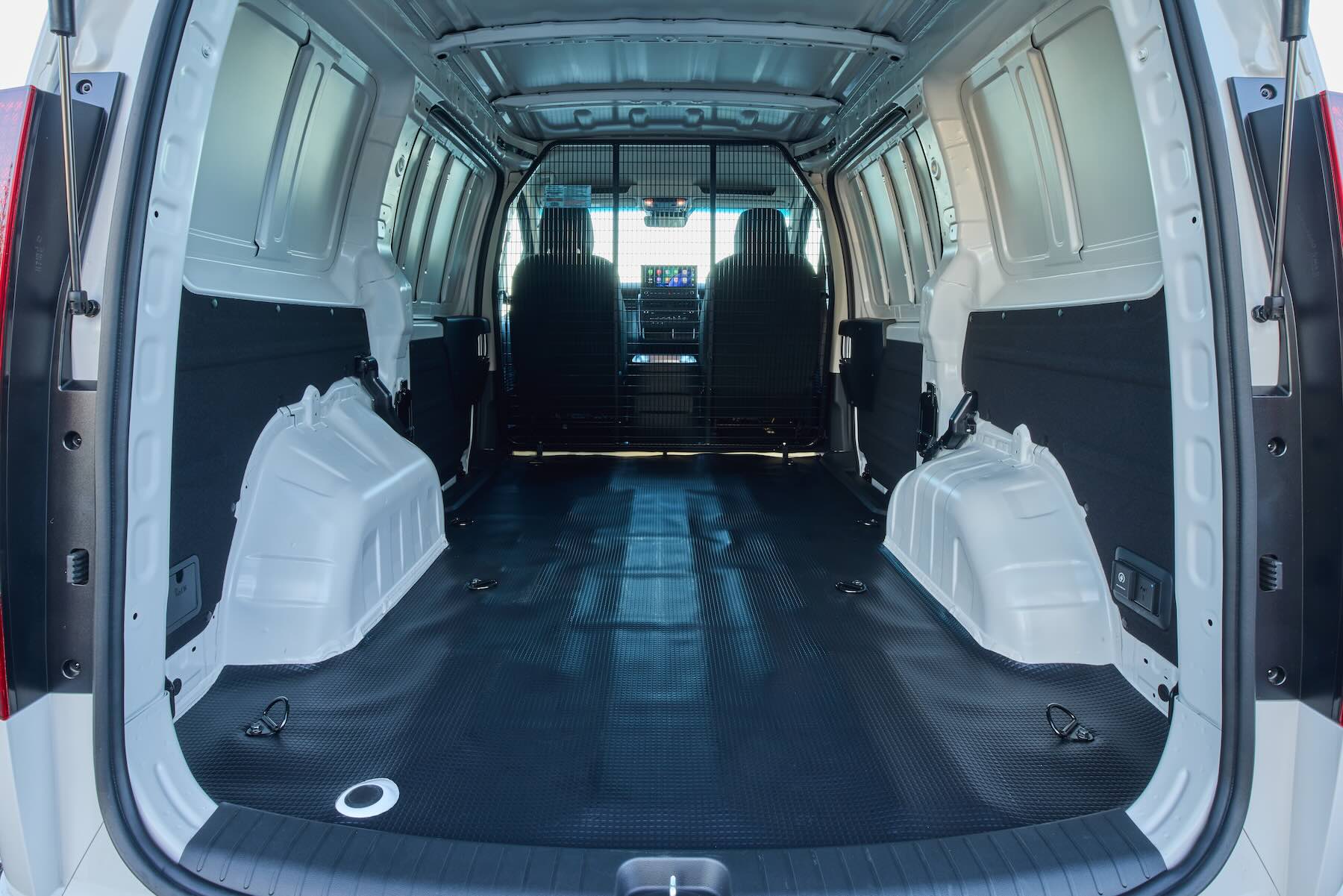
And this is where I think Hyundai has done a good job with the electric Staria. There’s 4,935 litres of cargo capacity, a payload of 1,005 kg and a braked towing capacity of two tonnes.
The cargo volume for this electric version is exactly the same as the diesel and hybrid variants.
There’s only one electric specification available, although buyers can choose between a conventional liftback tailgate and twin swing rear doors, both costing the same.
Another useful addition is interior Vehicle-to-Load (V2L) functionality, with a standard power outlet in the cargo area capable of delivering up to 4 kW, allowing tradespeople to power tools, computers and other equipment directly from the vehicle’s battery.
Climbing into the driver cabin, the first thing that struck me was just how much space there is.
At six foot five, finding a comfortable driving position isn’t always straightforward, even in some relatively large vehicles. But that’s certainly not an issue here.
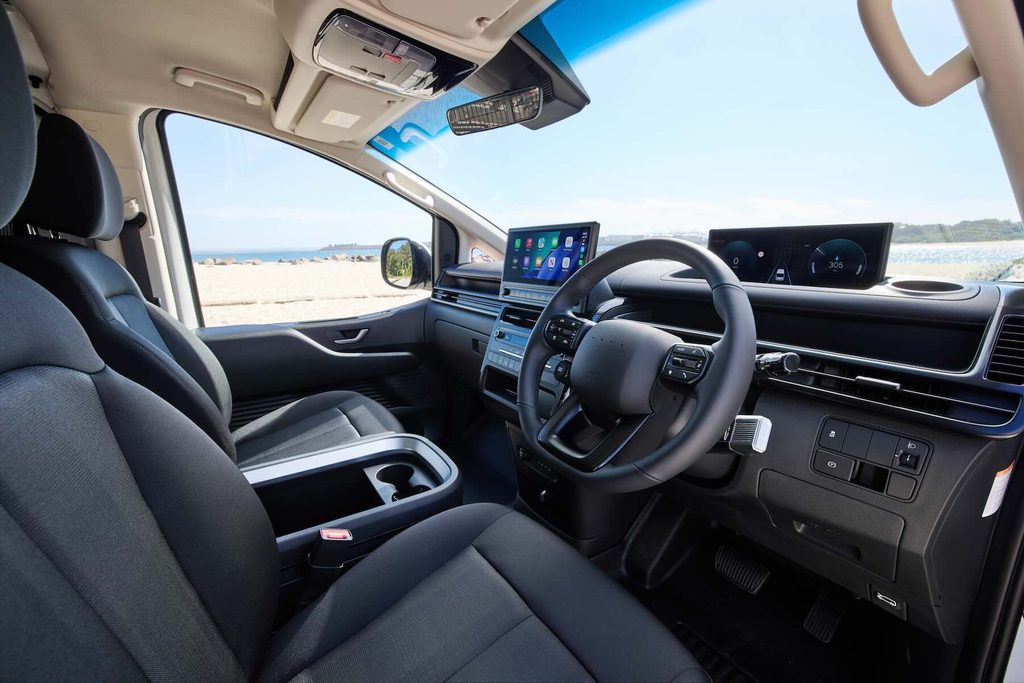
Headroom is enormous, and the combination of large windows and a spacious cabin gives the Staria a particularly open and airy feeling, with excellent visibility.
There are two 12.3-inch digital displays, one for the instrument cluster and another for the infotainment system.
The latter uses Hyundai Motor Group’s newer software platform, which is shared with several recent Kia models.
It’s noticeably more responsive than the older Hyundai infotainment system, with very little lag when moving between menus, while the digital instrument cluster is also a marked improvement over some previous Hyundai displays.
Wireless Apple CarPlay and Android Auto are included, along with a wireless phone charger, two USB-C ports and a 12V outlet. Physical buttons for the climate controls is always a welcome sight.
Storage is another strong point, with a large open centre console, additional compartments underneath, plenty of door storage and even an overhead compartment with a mesh net for documents and other small items. It’s a practical layout that makes good use of the enormous cabin.
One strange omission is a driver’s armrest, something I personally found myself wanting over the week that I had the vehicle.
But it isn’t the biggest omission from the cabin, particularly when you compare what you get in the Hybrid Premium version of the same vehicle, which at $61,240 before on-roads costs almost $10k less than the electric version.
Features found in the Hybrid Premium model but missing from the electric version include a 360-degree surround-view camera, heated front seats, a heated steering wheel, powered tailgate, auto-dimming rear-view mirror, Highway Driving Assist, LED headlights and LED rear lights.
The Hybrid Premium also gets 17-inch alloy wheels, while the electric Staria makes do with steel wheels.
The omission that bothered me most was the 360-degree camera. Even in considerably smaller vehicles, I’ve become accustomed to using surround-view cameras when parking and manoeuvring through tight spaces.
And if there’s one type of vehicle where that technology would be particularly useful, it’s a five-metre-long commercial van.
One would imagine drivers will regularly find themselves navigating narrow streets, loading docks, car parks and tight delivery spaces.
A reversing camera and parking sensors are included, but I think Hyundai should have made a surround-view camera standard, or at least offered it as an option.
I’d also welcome a digital rear-view mirror, particularly for operators carrying loads that obstruct the view through the rear window.
It’s a little frustrating because Hyundai clearly has access to these features. It already offers many of them elsewhere in the Staria range.
Fortunately once behind the wheel, the Staria Load Electric makes a much better impression
I think there are so many benefits to driving an electric commercial vehicle. If you’re spending five or six hours every day driving around town, the absence of a noisy diesel engine becomes a real advantage..
The cabin is impressively quiet, and combined with the generous interior space, it makes the Staria a genuinely comfortable place to spend an extended period behind the wheel.
The 160 kW electric motor provides more than enough power for the sort of driving this vehicle is designed to do.
Acceleration is smooth and responsive, and there’s plenty of performance available for negotiating city traffic or merging onto faster roads.
There’s even a Sport mode, which sharpens the accelerator response and adds a little urgency to proceedings.
The regenerative braking is well implemented, with several selectable levels and Hyundai’s i-Pedal mode allowing for effectively one-pedal driving.
For delivery drivers regularly stopping and starting in urban traffic, one-pedal driving should make a meaningful difference to both driving comfort and efficiency.
The suspension was another pleasant surprise. It’s worth noting at this point that much of my previous van-driving experience has involved the sort of Toyota commercial vans commonly found in car-sharing fleets. Compared with those vehicles, the electric Staria is considerably more refined.
The ride is smooth, bumps are handled well and there’s little of the rattling and creaking I often associate with older commercial vans.
Hyundai has fitted a multi-link rear suspension system and additional sound insulation, and the results are noticeable.
I found the Staria Load Electric surprisingly enjoyable to drive, particularly given its size and intended purpose, with the important caveat that my driving was undertaken with very little cargo on board.
How the suspension performs with a full payload, and what that does to driving efficiency, will require a more comprehensive test.
Over the week that I had the vehicle, which involved predominantly city driving, I averaged 16.5 kWh/100 km, which is a fair bit better than Hyundai’s official combined consumption figure of 20.7 kWh/100 km.
Again worth noting that the bulk of the driving I did involved relatively light loads and predominantly urban driving, conditions that generally favour electric vehicles. But I still think for a vehicle of this size and weight it’s an excellent result.
At that consumption rate, the 84 kWh battery would theoretically provide more than 500 kilometres of range, although that isn’t a realistic expectation for every driving scenario.
There’s plenty to like here. It’s spacious, practical, comfortable and surprisingly refined on the road.
The claimed 450 km range should be sufficient for many commercial applications, while the ultra-fast charging and 4 kW V2L functionality are genuinely useful additions.
And based on my week behind the wheel, the efficiency is particularly encouraging.
But it’s difficult to ignore that price tag.
At $70,990 before on-road costs, the Staria Load Electric is $21,000 more expensive than the diesel, $17,500 more than the standard hybrid and $9,750 more than the Hybrid Premium.
Those are significant differences for businesses that need to make purchasing decisions based on operating costs rather than simply wanting the latest technology.
The running costs of an electric vehicle can be substantially lower, particularly for businesses travelling large distances and charging overnight at their own premises. Apart from the fuel savings, the general maintenance costs for EVs are significantly lower compared to other drivetrains.
For fleet operators covering tens of thousands of kilometres each year, those savings combined with the benefits of the existing EV tax incentives available in Australia could eventually offset the higher purchase price.
The electric powertrain is well suited to commercial use, the cabin is exceptionally spacious, and the combination of useful cargo capacity and fast charging makes it a capable electric workhorse.
But there’s also a sense that Hyundai hasn’t quite got the overall package right.
The lack of a 360-degree camera, LED headlights and several other features available on the cheaper Hybrid Premium is difficult to understand. The $21,000 premium over the diesel remains a substantial hurdle.
This isn’t the first time I’ve felt Hyundai has produced an excellent electric vehicle but struggled to price it competitively.
It’s a genuinely good vehicle, and one I’d happily spend more time driving. But whether it’s a good purchase for Australian businesses is a more complicated question.
For operators covering substantial daily distances with access to affordable depot charging, the numbers could still stack up.
For others, particularly those unable to take advantage of cheaper electricity, the extra upfront cost may be harder to justify.
Still, the growing range of electric commercial vehicles is a welcome development. The transition to cleaner transport isn’t just about what Australians drive to work. It’s also about what they drive for work.


Comments
No approved comments yet. Be the first to comment.
Leave A Reply