US battery storage capacity set to double by 2028, EIA reports
Summary
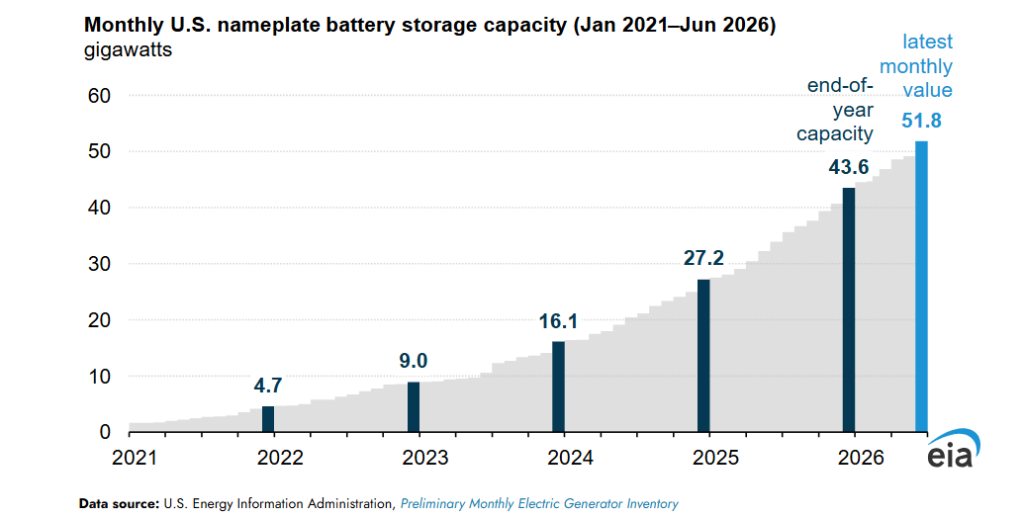
The US Energy Information Administration reports that utility-scale battery storage capacity could more than double by 2028, with operators planning an additional 54GW. The nation already has 43.6GW operational as of end-2025, growing at 70% annually.
Operators anticipate bringing an additional 54GW of battery storage capacity online over the next two and a half years, according to the US Energy Information Administration (EIA).
Utility-scale battery energy storage system (BESS) capacity in the US has grown at an average annual rate of 70% over the past three years, reaching nearly 52GW of nameplate capacity by mid-2026, according to the EIA’s latest Preliminary Monthly Electric Generator Inventory.
The US power system had 43.6GW of operational BESS capacity at the end of 2025. During the first six months of 2026, operators added another 8.3GW.
Operators have reported plans to bring an additional 54GW of BESS capacity online over the next two and a half years. Planned additions include 14GW in the second half of 2026, 26GW in 2027, and 14GW in 2028.
If these plans materialise, US battery storage capacity would more than double from current levels by the end of 2028.
Solar-coupled projects lead capacity
In June, market research firm Wood Mackenzie released its Q2 2026 US Energy Storage Monitor, stating that the US energy storage market would reach 200GW/655GWh of cumulative installed energy storage capacity by 2031, nearly quadrupling current capacity.
According to that report, 3.3GW/8.4GWh of BESS was installed in Q1 2026, with utility-scale, commercial and industrial (C&I), and residential segments all posting record Q1 installation numbers.
Solar PV plants host the largest BESS capacity units in the country. The Bellefield Solar and Energy Storage Farm, which began operations in December 2025, pairs 500MW of solar PV capacity with 500MW of nameplate power storage for the California Independent System Operator (CAISO).
Plans for the Bellefield facility include doubling both the solar PV and storage capacity, with the expanded capacity expected to be operational by November 2026.
The Manatee Solar Energy Centre in Florida, operational since 2021, was, at the time, the world’s largest solar-charged BESS, with 409MW of battery storage capacity paired with 75MW of solar capacity.
The Gemini Solar Hybrid in Nevada, which became operational in 2024, combines 690MW of solar PV capacity with 380MW of power storage capacity.
Solar PV and BESS facilities enable operators to store power when wholesale electricity prices are low and discharge electricity when prices are high, allowing power producers to capture larger profits. This arbitrage capability has become a key driver of battery storage deployment alongside renewable generation assets.


Comments
No approved comments yet. Be the first to comment.
Leave A Reply