BESS Industry Buzz: RE+ Takeaways, EU-Made Cost Premiums, and European Revenue Variability
Summary
The latest BESS Industry Buzz rounds up key discussions from the RE+ trade show in Las Vegas, including the massive US storage deployment wave and policy uncertainty facing developers. It also highlights Benchmark Mineral Intelligence data showing EU-made 4-hour LFP AC blocks at $243/kWh in 2026 versus $115/kWh in China, alongside European revenue and M&A trends.
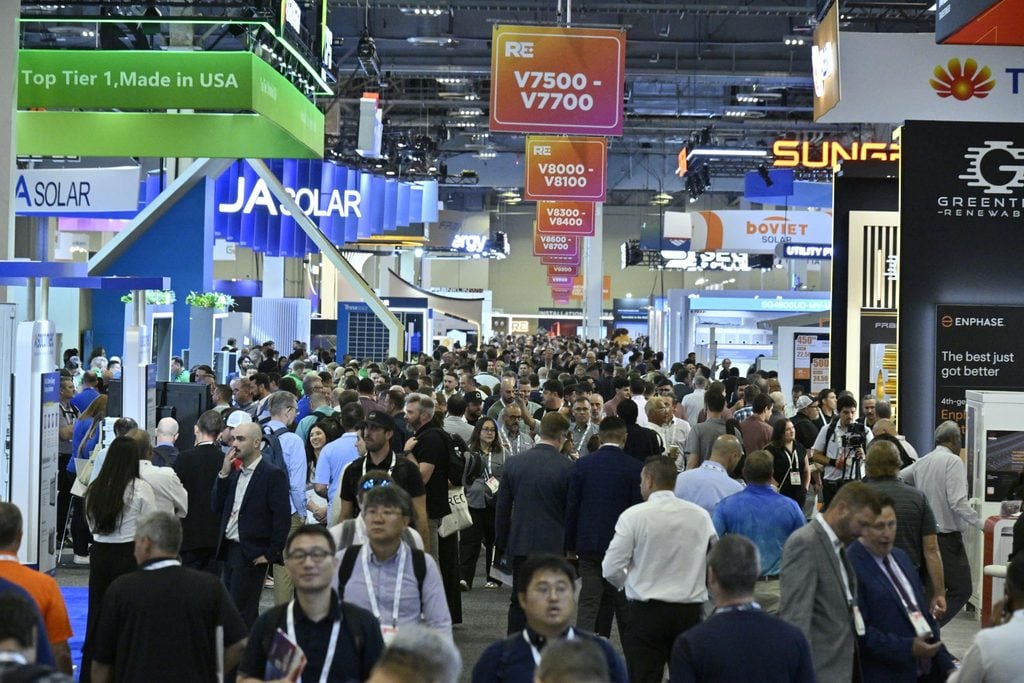
Another BESS Industry Buzz, looking at what people are discussing in the industry plus some of the most notable quotes from the RE+ trade show, which concluded yesterday.
US about to enter huge wave of deployment
“I’d like to sort of describe it as sort of just the wave about to breach in terms of how much energy storage is going to be starting to be commissioned.” — Benchmark Mineral Intelligence’s Pete Tillotson, on the scale of deployment about to hit the US market.
Trade policy is a headache
“It’s kind of like you are building a house from scratch, and then a month later you are introducing tariffs on the windows, and a month later you are told you cannot use the door from this country, or that you can use this door.” — OCI Energy president Sabah Bayatli, on the disorienting pace of policy and tariff changes mid-development.
We’re comfortable with fires; explosions scare us
“Fire marshals said, ‘We fight fires every day. We’re comfortable with fires. Explosions scare us.’ So I would rather have exhaust ventilation than an explosion, deflagration panel, where you don’t know what’s going to happen.” — Trina Storage’s Mike Watson, on the human reasoning behind a key fire-safety engineering choice.
Big gulf between EU-made and Chinese-made BESS
It’s something that everyone would assume anyway, but some numbers have emerged on the price difference between BESS made in the EU versus those made in China, and it’s big. Benchmark Mineral Intelligence data pegs an EU-made 4-hour LFP AC block at US$243/kWh in 2026, versus US$115/kWh in China. Marek Kubik discussed the gap and its significance and future in his LinkedIn post on it, read it here.
Poland: no locational market signals, but there are locational risks
There is no market benefit for a BESS being located in a specific location in Poland, writes Modo Energy analyst Alexander Kelham. But transmission and grid outages mean there are locational risks. See his post giving an overview of the country’s large-scale pipeline here.
Who is buying BESS in the UK right now?
The UK has always been a hotspot for BESS activity, and this year is no different with lots of companies buying up and investing in projects there. Stanislav Masevych, founder of AI-driven renewable energy market and business intelligence platform Greenvi AI, gave an overview of this M&A activity in 2026 so far, see his post here.
German revenues down
Germany battery revenues fell 34-35% in October due to falling aFRR (secondary reserve) prices, posted optimiser Enspired. Day-ahead spreads also narrowed, but energy arbitrage revenues held up relatively better.
Variability of Spanish revenues
How much does a battery earn in Spain? Xavier Lura of advisors Endura Energy says this depends significantly on the year in which you are talking about. The firm has built a free calculator so anyone can test a project on real day-ahead prices, read about it in his post here.
South Australia’s negative prices paid BESS to charge
South Australia accounted for 82% of negative pricing in Australia’s NEM over the first half of November, but holds only 15% of the fleet’s BESS capacity, according to Franz David Schaefer, senior analytics specialist at EnergyAustralia. As a result, 66% of the money paid to charge went to South Australian BESS units, equal to 42% of the state’s total energy revenue over the period and about 8% of the entire fleet’s.
Schaefer wrote that South Australia saw runs of more than two hours near -AU$320/MWh, which leave a charging BESS unit in the black even if it later sells at AU$0. In Queensland, negative intervals sat just below zero. He expects more competition for the lows as the South Australian fleet grows, as in other states, and said how long the supply and demand gap lasts is the big question.

Comments
No approved comments yet. Be the first to comment.
Leave A Reply