US BESS experts at RE+ 2026 weigh BAAJA permitting reform's impact on storage
Summary
Industry figures at RE+ 2026 in Las Vegas say the Bipartisan American Affordability and Jobs Act of 2026 could ease interconnection bottlenecks that are causing major pain for battery storage developers. The bill's permitting and transmission reforms drew both support and criticism over weakened environmental and Tribal protections.
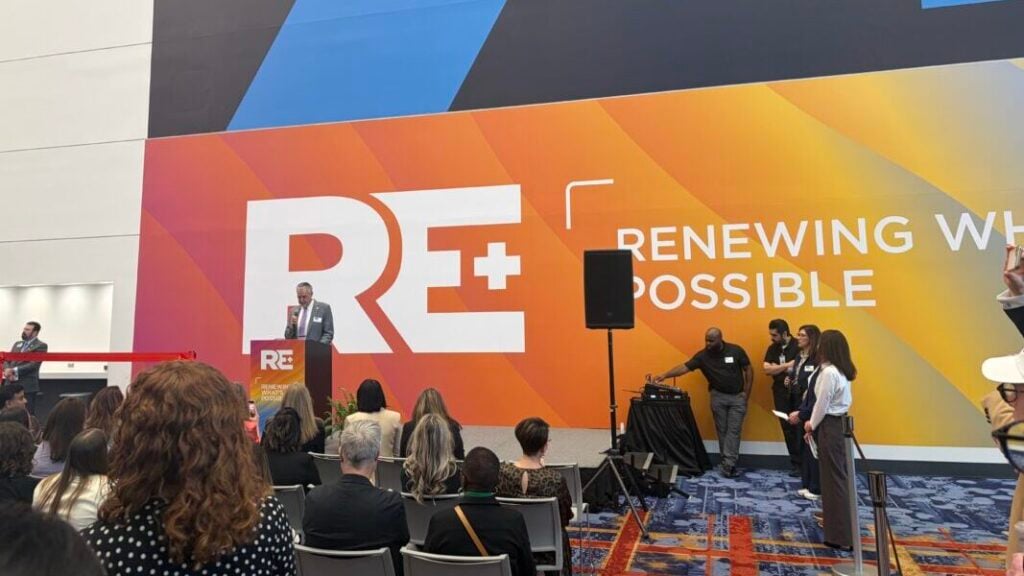
The Bipartisan American Affordability and Jobs Act of 2026 (BAAJA) has been a popular topic of discussion at RE+ 2026 in Las Vegas, Nevada, US.
Regular readers of Energy-Storage.news will almost certainly be familiar with the bill, which was introduced on 30 September by leaders of the Senate Environment and Public Works (EPW) Committee and the Energy and Natural Resources (ENR) Committee.
BAAJA overview
BAAJA aims to speed approval of US energy, transmission, and infrastructure projects by streamlining permitting and environmental reviews. It would amend key federal laws—including the National Environmental Policy Act (NEPA), the Clean Water Act (CWA), the Endangered Species Act, and the National Historic Preservation Act (NHPA)—to shorten reviews and limit some federal delays.
The bill would accelerate grid expansion by giving the Federal Energy Regulatory Commission (FERC) federal backstop authority over major interstate lines, requiring 20-year transmission plans, and promoting grid-enhancing technologies.
It would make high-energy data centres pay the full costs of power delivery and grid upgrades, protecting other ratepayers. It would also restrict courts’ ability to issue broad injunctions or invalidate certain permits and agency actions, giving developers greater legal and financial certainty.
Critics of the bill, such as the Natural Resources Defence Council (NRDC), the Native American Rights Fund, and Detention Watch Network, warn that it would weaken environmental and Tribal protections and could facilitate the expansion of immigration detention, making it politically risky despite potential gains for renewables and storage.
Industry voices at RE+
Sabah Bayatli, president of BESS and solar developer OCI Energy, told ESN that while both are critical, between interconnection challenges and supply chain procurement uncertainty, interconnection is “causing bigger pain” to the energy storage industry.
Bayatli continued, “(OCI) likes to believe (moving projects forward) is the whole intention (of BAAJA). FERC tried their best years and years ago, trying to push these markets to improve their processes. It was a very big topic in 2023, but frankly, we are in 2026, and we did not see any progress on that end, so it’s not helping.”
Other sources, market experts speaking to ESN on background, stated that while they had their own issues with the bill, it would ultimately speed up interconnection processes and help bring renewables online more quickly.
These sources highlighted the narrow window the lame-duck Congress has to pass the bill, arguing that the uncertainty over whether US President Donald Trump will support or oppose the new Congress’s actions makes it too risky to delay passage.
Tim Pawlenty, president of SEIA and former Republican Governor of Minnesota, at an event being held jointly by SEIA and Wood Mackenzie at RE+, called BAAJA “a really good bill” and a “near miracle” given it secured bipartisan support from four key senators and the White House on an issue where past efforts (including Joe Manchin’s) failed.
He warned the House poses the bigger risk, stating that some senior Democrats “would like to start over and do the bill from scratch,” which would make the outcome unpredictable.
Ben Norris, SEIA’s general counsel & senior vice president of regulatory affairs, said BAAJA would upend current interconnection strategies and create a massive implementation burden: “14 discrete rulemakings” for an already “understaffed” FERC, some with deadlines as short as 90 days.



Comments
No approved comments yet. Be the first to comment.
Leave A Reply