Bamboo-Derived Biofuel Could Cost $2.75 Per Gallon, Researchers Say
Summary
Researchers at Worcester Polytechnic Institute say bamboo's rapid growth and high yields make it a promising feedstock for low-emission biofuels. Their study suggests bamboo-derived fuel could be produced for about $2.75 per gallon, offering an alternative to corn ethanol.
At CleanTechnica, we are passionate champions of the “electrify everything” movement promoted by Tony Seba and Mark Jacobson, among others. However, being realistic, internal combustion engines will continue to play an important role in transportation by land, sea, and air for the remainder of this century and perhaps beyond.
Almost any plant that grows could potentially be turned into a biofuel with a lower emissions footprint than gasoline or diesel. Currently in the US, millions of tons of corn are used every year to make ethanol, which is then blended with gasoline. In theory, the ethanol helps lower emissions, but the reduction, if any, is modest and it decreases fuel economy, so motorist are actually using more fuel than they would if they used ordinary, unadulterated gasoline.
The other part of the equation is that the conversion process itself requires a fair amount of energy and makes its own greenhouse gas emissions, which politicians conveniently choose to ignore. Ethanol, then, is mostly a scam that rewards farmers, but has few other benefits. While the science is sound, the rewards are far less than claimed. However, farmers are an important political group and no one wants to tell them that corn for ethanol is no longer a thing.
Bamboo For Victory!
Researchers at Worcester Polytechnic Institute think they have found a better way. In a study published September 24, 2026 in the Royal Society of Chemistry journal Sustainable Energy And Fuels, Michael Timko, the head of the chemical engineering department at WPI, and Timothy Woodard, PhD, claim that bamboo may be the perfect source material for making biofuels. In the published study, they write:
“Corn stover, an agricultural residue widely available in the U.S., has been one of the most studied biomass sources for biofuel production.6 Yet its relatively modest yields and high ash content have created significant challenges for scaling up production. Alternative feedstocks such as switch grass have been explored, but these offer only incremental improvements in performance relative to corn stover, particularly in ash content and growth rate. These limitations highlight the importance of identifying and evaluating less conventional biomass sources that may offer superior attributes for fuel production.
“Bamboo has emerged as a strong candidate due to its rapid growth, high productivity per unit area, and low input requirements. Some bamboo species reach their full height within a few months and mature within four years. Bamboo’s deep root systems improve soil stability, promote subsurface carbon sequestration, and support water conservation. It can also be grown on marginal or degraded land, reducing competition with food crops and offering economic opportunities for rural communities.
“Critically, bamboo also possesses an exceptionally low ash content compared with most lignocellulosic feedstocks, which minimizes inorganic fouling and catalyst poisoning during thermochemical conversion and improves the quality of the resulting biocrude. Furthermore, the presence of ash complicates thermochemical conversion to products, with frequently reported adverse effects on yields.
“The characteristics of fast growth, low fertilizer and water use, and low ash content make bamboo stand out as a promising source of biomass that can achieve economic competitiveness that has not been obtained with other feedstocks. Unfortunately, despite these advantages, bamboo remains largely underexplored as a feedstock for liquid fuel production, especially in thermochemical conversion processes such as hydrothermal liquefaction (HTL).”
Here’s the best part. The researchers believe biofuel from bamboo could be commercially viable at a price of $2.75 a gallon. That’s less than gasoline at the moment and less than half the cost of diesel. What’s more, when compared to diesel, the resulting emissions are up to 26 times lower. So let’s see: Less than half the cost and only 5 percent of the emissions? Think anyone would take that deal? Oh, you betcha!
Fast Growing
Bamboo is a grass, and one of the fastest-growing plants on Earth. Some species grow several dozen inches in a day. Because of this fast growth, the US could make as much fuel from bamboo as it makes ethanol from corn while using only 13 percent as much land.
“I think this research is especially timely and important because fuel prices are high and the transportation sector produces more greenhouse gas emissions in the U.S. than any other,” said professor Timko in a press release. “Bamboo would use different land than we are using for food production, so there is no food versus fuel trade-off. Farmers win, consumers win.
Using bamboo for fuel can reduce greenhouse gasses in two ways, the researchers maintain. First, the process to convert it into biocrude is more efficient than it is for other feedstocks. Second, bamboo itself captures and stores large amounts of carbon both above and below ground.
Unlike annual crops used for many biofuels, bamboo is a perennial grass that can produce large amounts of biomass with relatively low agricultural inputs. Compared with other perennial grasses, bamboo has very low ash content (less than 1% by dry weight), meaning that the conversion process generates negligible waste.
The economic modeling conducted by the researchers indicates that bamboo-based fuel could sell for as little as $2.75 per gasoline equivalent under mature commercial-scale conditions, accounting for the money required to build and operate the fuel plant, suggesting strong economic competitiveness as the renewable-fuel industry expands. Considering the ability of bamboo to store large amounts of carbon in its underground rhizomes, producing fuel from bamboo would generate a greenhouse gas intensity of 3.5 grams of carbon dioxide-equivalent per megajoule of energy, the researchers report.
Crop Circles
“The U.S. has enormous land area under cultivation for corn ethanol, a fuel which is often blended into gasoline,” said professor Timko. “Freeing up at least some of that land could allow for more food production and reduce the burden on the environment. Bamboo may eventually offer industry a way to generate low carbon liquid fuels at scale. With further research and development, bamboo could be a compelling option for decarbonization in sectors that are difficult to electrify, including heavy duty transport and aviation fuel supply chains.”
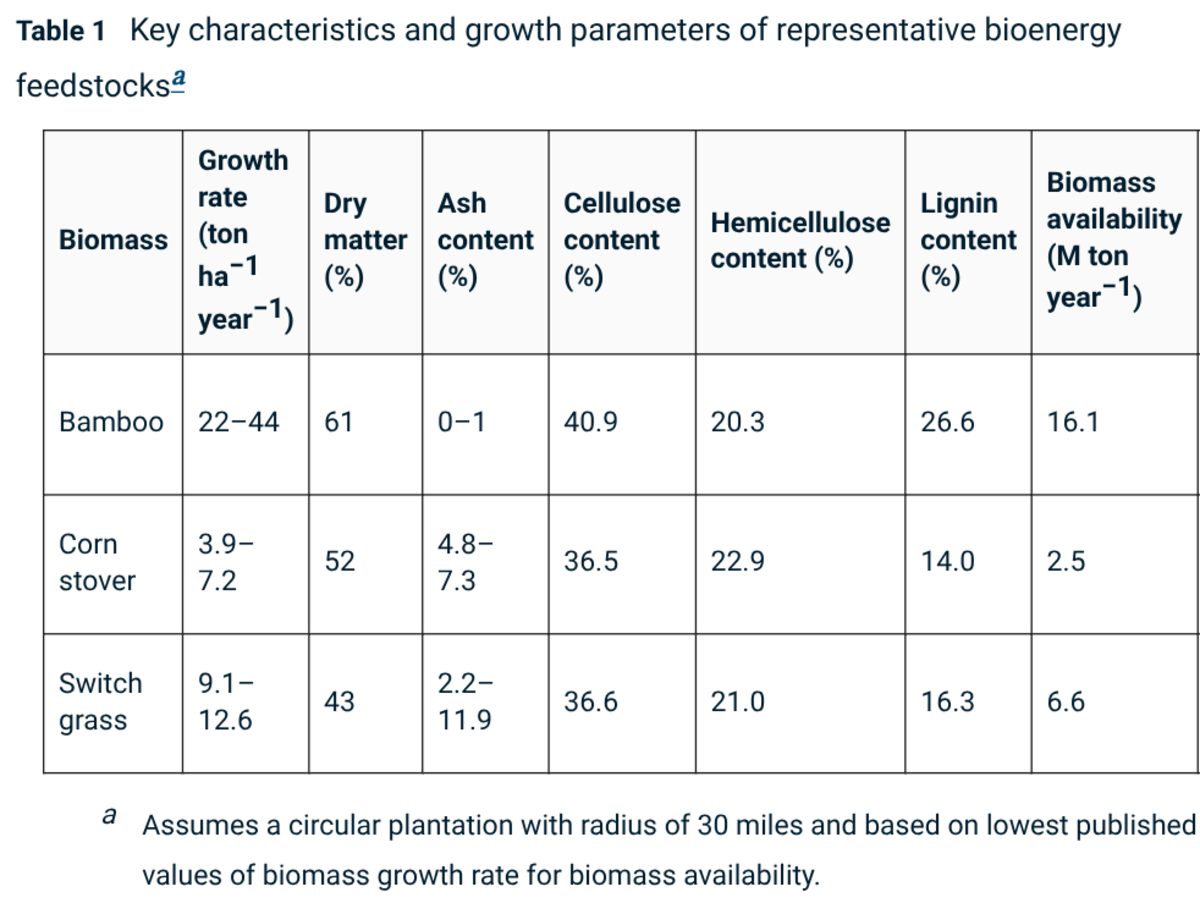
The researchers also point out that bamboo can be cultivated on former industrial land or heavily farmed properties where other crops and vegetation struggle to grow. Their research found the growth rate of bamboo (22–44 tons per hectare per year) “is at least three times that of corn stover and at least twice that of switch grass.
Based on the lowest growth rate, an idealized circular [bamboo] plantation with a 30 mile radius corresponds to an estimated 16.1 million dry tons of biomass per year. Ash content, a critical parameter for processing efficiency and waste generation, was less than 1 percent in bamboo, compared with 4.8–7.3 percent for corn stover and 2.2–11.9 percent for switch grass.
With such data in mind, expect the current US administration to impose a heavy tax on bamboo based biofuel to protect the profits of the oil industry and corn growers. Nothing must be allowed to challenge the hegemony of fossil fuels or the profits of Big Ag. And please don’t tell the head doofus that the WPI research was funded in part by Pacific Northwest National Laboratory and the National Science Foundation. If he found that out, his head might explode!



Comments
No approved comments yet. Be the first to comment.
Leave A Reply