GICON's 300-Meter Wind Tower Prototype Faces Competition From 199-Meter Hybrid Towers
Summary
GICON has completed a 300-meter hub-height wind turbine prototype at Schipkau using a lattice structure and telescoping inner tower that avoids conventional cranes. Modeling suggests the taller design yields about 11.4% more annual output than a 199-meter hybrid tower, but construction complexity and cost timing complicate the commercial case.
Germany’s GICON has completed one of the more remarkable wind-turbine construction projects in recent years. Its Schipkau prototype reached a hub height of 300 meters in September, putting the upper blade tip at a reported 365 meters. The lattice structure and telescoping inner tower allow the turbine assembly to be raised into place without a conventional crane lifting it to that extreme height. The engineering achievement is substantial, and the attraction of stronger winds higher above the ground is easy to understand.
But while GICON was developing its tower, conventional wind towers were getting taller too. Max Bögl recently erected a Vestas V172-7.2 MW with a 199-meter hub on a series-production hybrid tower. That changes the commercial comparison considerably. The generation advantage of reaching 300 meters looks impressive against a conventional tower at 100 or 150 meters. It becomes a different proposition when developers can already choose a hub approaching 200 meters.
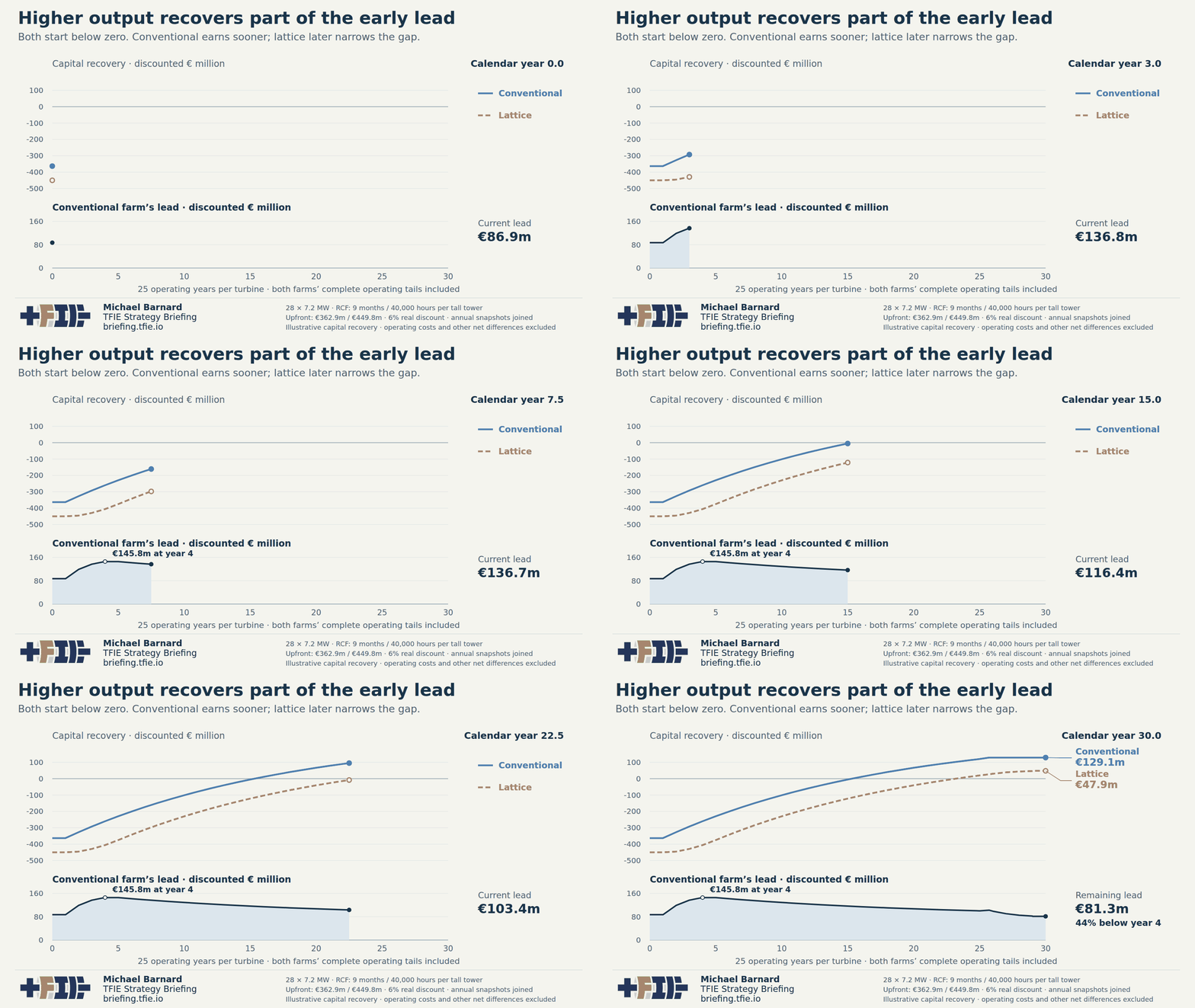
I modeled two hypothetical wind farms using identical 7.2 MW turbines, rotor diameters and turbine counts, changing only their hub heights from 199 to 300 meters. Under the screening model’s wind assumptions, the taller farm produces 11.4% more electricity annually. That’s valuable additional output from the same generating equipment, although the gain varies considerably with the site’s vertical wind profile. Measurements at Schipkau suggest that some locations could do substantially better.
The construction question is less straightforward. GICON’s approach addresses some of the transport and lifting problems associated with very tall conventional towers, but a giant lattice structure has a different assembly burden. The prototype required thousands of components and extensive work at height. The published construction record also includes an interruption for steel-quality checks. Future towers should benefit from the experience, although repeat construction costs and schedules have yet to be established.
That timing matters. Turbines begin earning as they enter service, while construction costs arrive much earlier. My assessment models both farms’ progressive commissioning, additional electricity, field labor and discounted receipts using a provisional reference-class construction allowance. The results show how strongly the commercial case depends on repeatable installation performance, with important costs still requiring supplier quotations.
There will be sites where reaching stronger winds at 300 meters is attractive, particularly where existing permits, land access or grid connections make additional production valuable. Schipkau has established that an extreme-height tower can be built. Whether the approach becomes commercially competitive depends on what subsequent installations achieve.
The full assessment examines the construction evidence, alternative labor and scheduling assumptions, financial thresholds, and the implications for wildlife and site selection. It’s available in TFIE Strategy Briefing, along with the assumptions supporting the model.


Comments
No approved comments yet. Be the first to comment.
Leave A Reply