Study: Europe's Inland Shipping Models Underprice Renewable Diesel, Making Battery Swapping €551/Day Cheaper
Summary
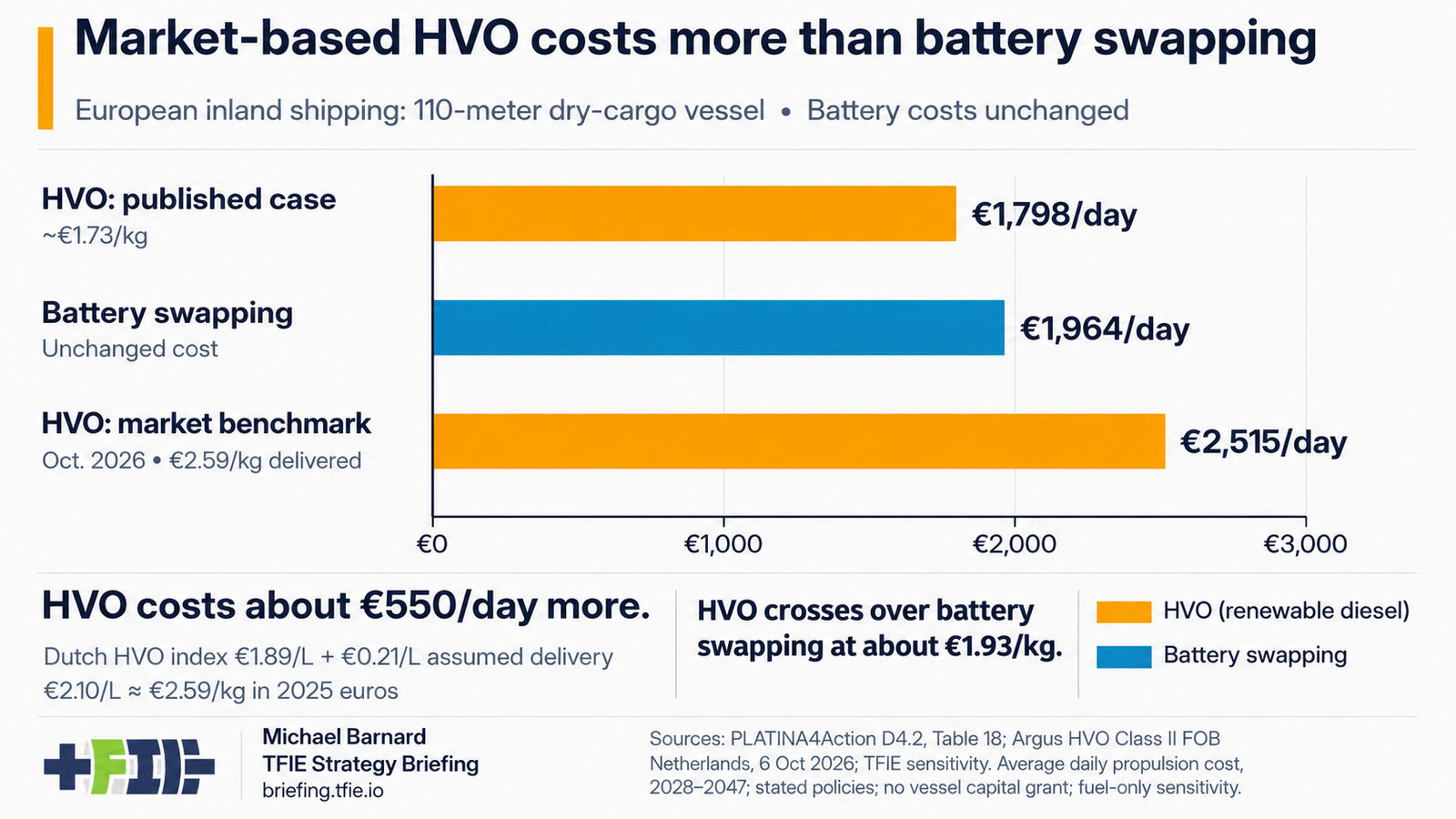
PLATINA4Action modeling puts HVO propulsion at €1,798/day versus €1,964/day for battery swapping on a new 110-meter dry-cargo vessel, but applying observed Dutch HVO market prices raises HVO to €2,515/day. The market-price check reverses the model's claimed HVO advantage and highlights assumptions favoring renewable liquid fuels over direct electrification.
Europe’s inland-shipping models underprice renewable diesel. For a new 110-meter dry-cargo vessel, PLATINA4Action calculates HVO (hydrotreated vegetable oil) propulsion at €1,798/day against €1,964/day for battery swapping. Apply the observed October 2026 Dutch HVO market price, including delivery, and the HVO cost is €2,515/day. Battery swapping is €551/day cheaper. The model’s claim of an HVO cost advantage fails a market-price check.
The gap between the modeled HVO price and observed market prices matters for the investment choices these studies inform. It also exposes a wider pattern. European studies give renewable liquid fuels favorable future prices while expecting marine batteries to remain expensive for much longer than the broader battery market suggests.
The Central Commission for the Navigation of the Rhine (CCNR) commissioned the original transition study behind its 2021 roadmap. Its scenarios influenced subsequent work, including the EU-linked PLATINA4Action and SYNERGETICS projects. Those projects do not all use identical models, but their assumptions and recommendations contribute to a shared policy picture in which several combustion pathways are expected to remain competitive with direct electrification.
In the full TFIE assessment, I converted the October 2026 Dutch Class II HVO wholesale benchmark, added a delivery allowance and expressed the result in 2025 euros. The market-based HVO cost is €2.59/kg. Battery swapping becomes cheaper than HVO in the PLATINA4Action 110-meter vessel comparison at approximately €1.93/kg. At that observed market price, modeled HVO propulsion costs €2,515/day over the model’s 2028–2047 ownership period, against €1,964/day for swapping. The model puts fossil diesel at €1,844/day, leaving swapping about 7% above diesel but 22% below market-priced HVO.
The price difference matters to freight operators. CCNR’s 2026 cost indices allocate fuel 35% of dry-bulk costs, 30% of tanker costs and 28% of container shipping costs. Operators compete for cargo against rivals still burning diesel. Expensive alternative fuels cannot be passed through to customers merely because a transition scenario requires them.
An April 2025 statement from European inland shipping and port organizations called for enough HVO at diesel-competitive prices to supply 1.6 million tons annually by around 2030. That quantity roughly matches the sector’s entire conventional diesel consumption in 2015. It exceeds the EU’s 2025 sustainable aviation fuel supply of 1.1 million tons by about 45%.
HVO and conventional biodiesel compete for oils and fats also used to produce aviation fuel. Aviation has fewer practical routes to electrification, and its European mandates create demand for renewable kerosene. An HVO-centered inland strategy puts barges in direct competition with aircraft for constrained feedstocks, even where barges can draw electricity from a corridor network.
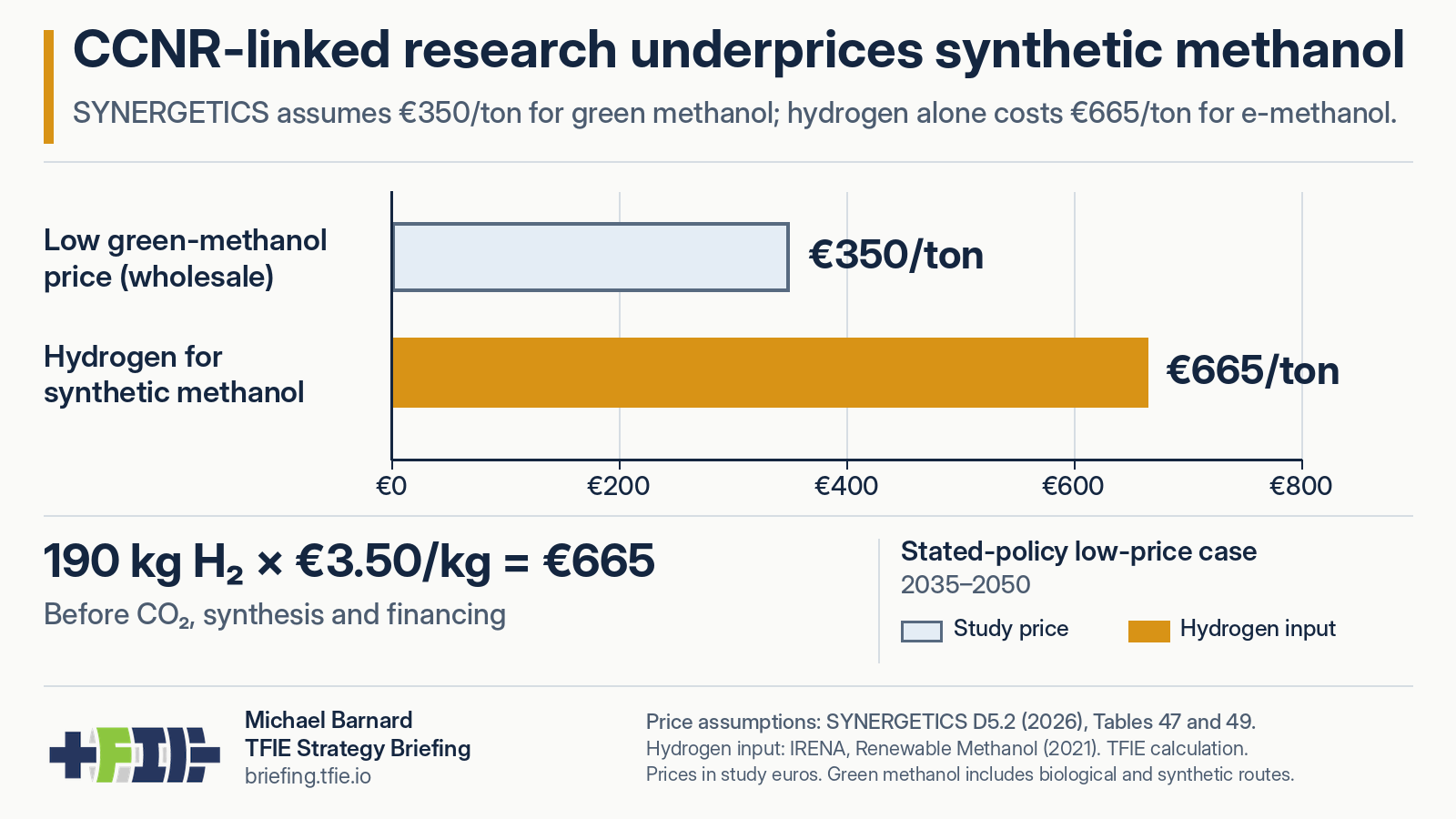
Synthetic fuels present an even sharper problem. SYNERGETICS gives green methanol from biological and synthetic routes a combined low wholesale price of €350/t in its stated-policy case from 2035. That same scenario uses a low green-hydrogen price of €3.50/kg. Producing a ton of synthetic methanol takes about 190 kilograms of hydrogen, costing €665 before carbon dioxide, synthesis, financing and delivery. The hydrogen input alone costs almost twice the assumed low finished-fuel price.
Biomethanol is a different production route. It can be made from agricultural and forestry residues, and I expect it to play a useful role in deep-sea shipping. Grouping biological and synthetic methanol together conceals the economics of each. For inland waterways, the relevant competitor is often electricity delivered directly to the propeller, not fossil methanol replaced with greener methanol.
The battery forecasts lean in the opposite direction. SYNERGETICS places 2030 marine battery storage at €210–€520/kWh, a €365 midpoint. My inland freight electrification report models standardized marine battery containers at €100/kWh in 2030, including the marine safety and container systems, with vessel integration costed separately. A €265/kWh difference adds €1.06 million to a 4 MWh battery installation before operating the vessel. The full fleet-level analysis also prices spare batteries, financing, charging infrastructure and equipment held in reserve.
The studies’ fleet assumptions compound the fuel-price choices. One PLATINA4Action case requires a large Rhine or Danube pusher to go seven days without replenishing energy, excluding intermediate charging or exchange from the test. The SYNERGETICS SYNFEED model starts every new vessel with a Stage V combustion engine, leaving electrification to later retrofits. Those are consequential design choices for a transition modeled through 2050.
Freight demand should be modeled before fuel demand. Mineral oil products, coal and iron ore accounted for 35.7% of Rhine cargo mass in 2025. CCNR’s own underlying economic projections point toward large declines in coal, refining and primary metals, even as construction and trade grow. The amount and composition of freight needing propulsion in 2050 will differ from today’s cargo mix.
The Netherlands has already reduced its 2040 hydrogen demand expectations and identified electricity as the main inland-shipping pathway toward 2050. CCNR is revisiting its transition work. The new analysis should start with the freight that will actually move, calculate route energy and charging or exchange needs, and then test the remaining fuel demand against prices reflecting aviation, deep-sea shipping and industrial competition.
Technology neutrality is a method of comparing alternatives, not an obligation to finance every fuel pathway. With HVO priced against market evidence and batteries costed realistically, the investment case for parallel fuel infrastructure weakens.
The full TFIE Strategy Briefing assessment walks through the CCNR, PLATINA4Action and SYNERGETICS cost assumptions, the HVO crossover and the synthetic-fuel arithmetic. The open inland freight electrification report contains the route, fleet and infrastructure model.
Subscribe to TFIE Strategy Briefing for independent assessments of the costs and strategic choices shaping decarbonization.



Comments
No approved comments yet. Be the first to comment.
Leave A Reply